

Dr. Batul Patel (Dermatologist)
Medical Director – The Bombay Skin Clinic
Dr. Batul Patel is an award winning certified dermatologist, honoured as the “Dermatologist of the Year 2023” at the national level by The Economic Times. View profile
What is Laser Pigmentation Treatment | Benefits of Laser Pigmentation | Ideal Candidates for Laser Pigmentation | Laser Safety & Side Effects | Laser Pigmentation Treatment Price |
What is laser treatment for pigmentation?
Laser treatment for pigmentation is an in-clinic procedure where controlled light energy is used to target excess melanin in dark spots or patches. The goal is to lighten unwanted pigment gradually, while protecting surrounding skin. To understand how lasers work and who they are suitable for, it helps to start with the basics of pigmentation.
What is skin pigmentation and why does it become darker?
Skin pigmentation refers to the colour of your skin, which is mainly decided by a pigment called melanin. When certain areas of the skin make more melanin than the surrounding skin, you see dark spots or patches. This is called hyperpigmentation and it can show up as melasma, sun spots, age spots, tanning, or marks left behind after acne or injury.
In a city like Mumbai, strong sunlight, pollution, hormonal changes, heat, and past skin inflammation are common reasons for pigmentation. Some conditions are mostly cosmetic, while others may be linked to internal health or medications. This is why a dermatologist’s assessment is important before planning any laser pigmentation treatment in Mumbai.
How do lasers reduce pigmentation?
Laser treatment for pigmentation uses focused light energy to target excess melanin inside the skin. The laser beam is tuned to a specific wavelength that is preferentially absorbed by pigment. Short pulses of light break the pigment into smaller fragments, which are then gradually cleared by the body’s natural repair processes over weeks to months.[1,2]
At The Bombay Skin Clinic, laser pigmentation treatment is always planned after a detailed consultation. The aim is to gently reduce excess pigment while protecting the surrounding skin, especially in Indian skin tones that can be more prone to post-inflammatory hyperpigmentation.
Key advantages of laser pigmentation treatment
Benefits of dermatologist-led laser pigmentation removal
When done under an experienced dermatologist, laser treatment for pigmentation in Mumbai can offer several advantages compared to using only creams or home remedies:
- Targets deeper or stubborn pigment that may not respond well to topical creams alone.[2,6]
- Acts in a focused way on pigment, leaving most of the surrounding skin unaffected.
- Can be combined with chemical peels, medi-facials, and prescription creams for more comprehensive pigmentation management.[3,5]
- Session times are relatively short, which is convenient for working professionals.
- Customisable energy settings allow safer use on a range of Indian skin types when handled correctly.
When laser may be used alone vs in combination with other treatments
Laser pigmentation removal is rarely the only solution. Most evidence supports using lasers as an adjunct to sun protection and topical or other in-clinic treatments, especially for melasma and pigmentation in skin of colour.[3-5]
- Laser alone: Sometimes for small, well-defined sun spots, freckles, or isolated pigmented lesions after proper evaluation.
- Laser plus creams and sunscreen: Common for melasma, post-inflammatory hyperpigmentation, and mixed patterns.[3,6]
- Laser plus peels or microneedling: In selected cases and only when the skin barrier is healthy, to support more even tone.
The exact plan depends on your diagnosis, skin sensitivity, lifestyle, and how quickly you need to return to regular work or social events.
Who is (and is not) a good candidate for laser treatment for pigmentation?
Who may benefit from laser pigmentation treatment?
You may be a suitable candidate for laser pigmentation treatment in Mumbai if:
- You have visible dark spots or patches such as melasma, sun spots, freckles, or acne marks.
- Your pigmentation has persisted for several months despite basic skincare and sun protection.
- You are willing to follow strict sunscreen and skincare advice before and after laser sessions.[1,2]
- You understand that results vary and that pigmentation can recur, especially with sun exposure or hormonal changes.[3]
Who should avoid or delay laser treatment for pigmentation?
Your dermatologist may advise postponing or avoiding laser treatment if:
- You are pregnant or breastfeeding, where many cosmetic procedures are usually deferred as a precaution.
- You have very recent tanning, sunburn, or active skin infection in the treatment area.
- You have a history of keloids or very problematic scarring in the same site.
- You are on certain photosensitising medications or have medical conditions that make laser unsafe without further clearance.[2]
- You are looking for a quick “one-session fix” or expecting permanent, guaranteed results, which is not realistic for pigmentation.[3,5]
Special considerations for Indian / darker skin tones
Indian and other darker skin types contain more melanin and can react differently to lasers. While Q-switched and other pigment lasers are widely used, they must be applied with great care to avoid darkening, lightening, or textural changes.[3,5,6]
At The Bombay Skin Clinic, we use conservative settings, gradual treatment plans, and patch tests where needed. We also build a strong focus on sun protection and topical maintenance, as these steps have a major impact on whether your results are maintained.
Types of pigmentation we treat with lasers at The Bombay Skin Clinic
Common pigmentation concerns (melasma, sun spots, freckles, PIH, tan)
Laser pigmentation removal at our Mumbai clinics can be considered for a range of concerns after proper diagnosis:
- Melasma on the cheeks, forehead, nose, or upper lip.
- Sun spots and age spots on the face, neck, arms, or hands.
- Freckles in fairer to medium skin types.
- Post-inflammatory hyperpigmentation (PIH) after acne, minor procedures, or injury.[1,2]
- Certain types of uneven tan that do not settle with routine care.
Some causes of pigmentation, for example those linked with internal disease or medications, may not be suitable for laser. In such situations, medical work-up and systemic management come first, and lasers may be a supportive option only after clearance.
Pigmentation patterns commonly seen in Mumbai patients
Living in Mumbai means daily exposure to tropical sun, humidity, and air pollution. We often see:
- Melasma or diffuse pigmentation in office-goers who commute long distances or spend time outdoors during peak sun hours.
- Acne-related dark marks in younger adults, especially when pimples are picked or squeezed.
- Neck and jawline pigmentation in people with friction from collars, jewellery, or mask use.
- Tanning and patchy darkness on the forearms and hands in those with outdoor work.
These lifestyle and environmental factors are discussed during your consultation. Addressing them alongside laser treatment helps support more stable results.
Laser technologies used for pigmentation at our Mumbai clinics
Q-switched Nd:YAG and laser peel treatments for pigmentation
Q-switched Nd:YAG lasers are widely used for pigment-related concerns, as they deliver very short, high-intensity pulses that target melanin with limited surrounding damage when used correctly.[3,6]
At The Bombay Skin Clinic, Q-switched Nd:YAG-based protocols may include:
- Focused spot treatments for individual dark spots or freckles.
- Low-fluence “laser toning” style protocols for selected melasma or diffuse dullness, always with caution and under close follow-up.[3,6]
- Laser peel-style treatments that gently refresh texture and tone while addressing superficial pigmentation.
Fractional lasers, IPL and other light-based options
In some cases, other light or laser technologies may be considered:
- Fractional lasers that create microscopic treatment zones, helping with texture and some forms of deeper pigmentation.[3,5]
- Intense pulsed light (IPL) for certain vascular and pigment patterns in suitable skin types.[3]
- Combination protocols where fractional or IPL sessions are alternated with Q-switched sessions, peels, or microneedling.
These devices are used selectively in Indian skin and are not suitable for every patient or every type of hyperpigmentation. The aim is always to balance visible improvement with a strong safety margin.
How we choose the right laser for your skin type and concern
During your visit, the dermatologist assesses:
- The depth and pattern of pigmentation (epidermal, dermal, or mixed).[2,3]
- Your medical history, medications, and past cosmetic procedures.
- Your lifestyle, sun exposure, and ability to follow aftercare guidelines.
Based on this, we decide whether a Q-switched Nd:YAG laser, fractional device, or another approach is appropriate, or if your skin is currently better suited to non-laser options. In some situations, we may advise delaying or avoiding laser and focusing first on medical treatment and strict sun care.[3,5]
How laser treatment for pigmentation works (science made simple)
Step-by-step: from consultation and patch test to your first session
The typical journey for laser pigmentation treatment in Mumbai at The Bombay Skin Clinic looks like this:
- Consultation and diagnosis: Detailed history, dermatoscopic examination, and sometimes additional tests if needed.[2]
- Prepping the skin: A customised skincare and sun-protection plan is started days to weeks before the first session.
- Patch test (where appropriate): A small test area may be treated first, especially in sensitive or darker skin types, to observe your response.
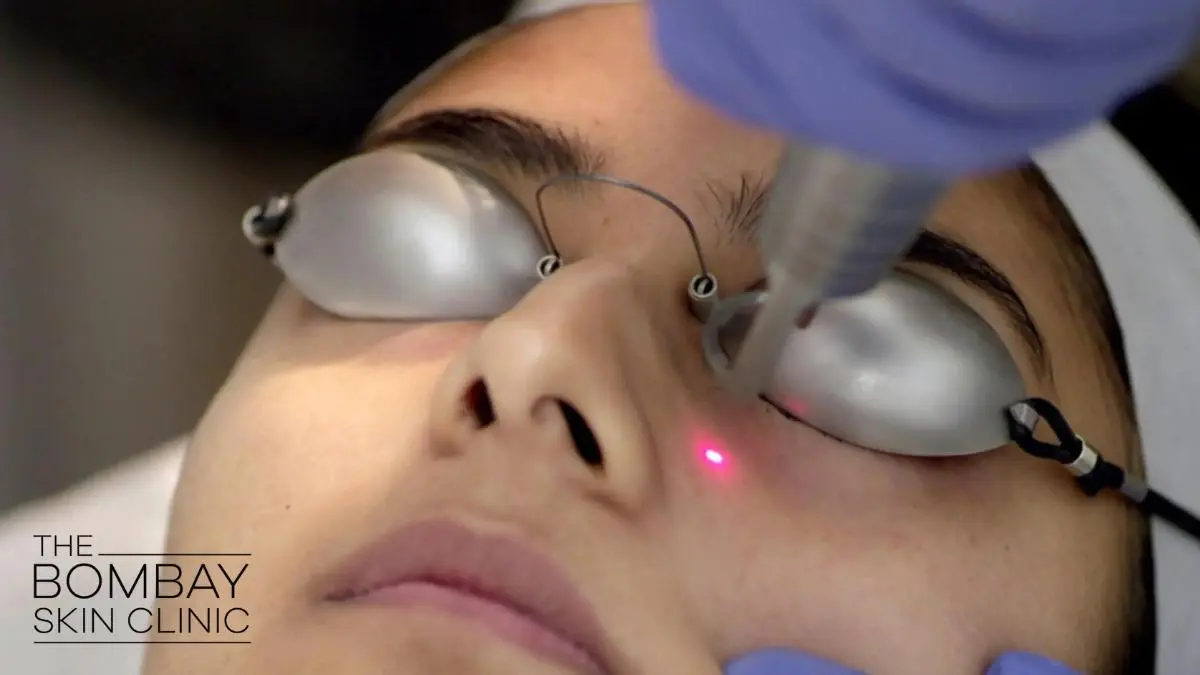
- Laser session day: The skin is cleansed, eye protection is placed, and topical numbing cream may be applied for certain procedures.
- Laser delivery: Short pulses of light are delivered over the targeted area, with cooling and monitoring throughout.
- Immediate recovery: Mild redness or warmth is common; a soothing product and sunscreen are usually applied before you leave.
What happens inside the skin during a laser pigmentation session?
When the laser light reaches the skin, melanin absorbs much of this energy. In pigment-specific lasers, this energy is converted to heat within very short pulses, causing the pigment particles to break apart.[3,6]
Over the next days to weeks:
- Some superficial pigment may darken slightly and then flake or fade.
- Deeper pigment fragments are cleared gradually by immune cells.
- The surrounding skin structure remains largely intact when parameters are chosen correctly.
Multiple sessions are usually needed because we want to work gently, allow healing between sessions, and manage triggers such as sun exposure and hormones at the same time.
Session plan, comfort and downtime
How many laser sessions are usually needed for pigmentation?
The number of laser sessions depends on the type and depth of your pigmentation, device used, and how well you follow home care. As a broad indication:
- Small, isolated spots may need a few sessions.
- Melasma and diffuse facial pigmentation often need a course of multiple sessions spaced a few weeks apart, combined with ongoing topical care.[3,5]
- Maintenance or “top-up” sessions may be advised later if triggers such as sun exposure cannot be fully controlled.
Your dermatologist will discuss a personalised course rather than promising a fixed number for everyone.
What to expect during each laser pigmentation session
A typical laser pigmentation session at The Bombay Skin Clinic involves:
- Arriving with clean skin, without makeup or strong actives.
- Skin cleansing and possibly gentle priming by the therapist under dermatologist supervision.
- Application of protective eyewear for you and the treatment team.
- Laser passes over the treatment area, during which you may see brief flashes of light and hear clicking sounds.
- Post-laser soothing application and discussions about aftercare and next steps.
Pain, numbing and comfort measures
Most patients describe pigment lasers as a feeling of quick, snapping rubber bands or warmth on the skin. Sensitive areas may feel more intense. To improve comfort, we may use:
- Topical numbing cream for selected procedures.
- Cooling devices, fans, or cold compresses before and after passes.
- Shorter sessions with breaks if you are anxious or have a low pain threshold.
The aim is to keep you comfortable while still delivering adequate energy for the pigment being targeted.
Downtime, social downtime and when you can get back to work
In many cases, there is minimal true downtime after laser pigmentation treatment in Mumbai, especially when conservative settings are used. However, mild and temporary changes are common:
- Redness, warmth, and slight swelling for a few hours to a couple of days.
- Darkening of treated spots before they fade or flake in the following days.
- Mild dryness or roughness in the treated area.
Most people can return to desk work within a day, provided they are comfortable with temporary redness or darkening and they follow strict sunscreen and skincare advice. Your dermatologist will guide any specific restrictions for exercise, heat exposure, or makeup based on the procedure done.
Safety, side-effects and contraindications
Is laser treatment for pigmentation safe for Indian skin tones?
Studies suggest that when used properly, pigment lasers and fractional lasers can improve melasma and other hyperpigmentation in skin of colour, but they need cautious use because darker skin is more prone to post-inflammatory pigmentation changes.[3,4,6]
To maximise safety at The Bombay Skin Clinic, we focus on:
- Accurate diagnosis and realistic goal setting.
- Gradual treatment plans rather than aggressive, high-energy single sessions.
- Meticulous sun protection and topical support before and after procedures.
- Close follow-up, particularly in the first few weeks of treatment.
Common, temporary side-effects you may notice
Short-term side-effects that may occur after laser pigmentation treatment include:
- Redness and mild swelling.
- Warmth or a mild burning sensation that settles within hours.
- Temporary darkening or bronzing of spots before they lighten.[3]
- Dryness, flaking or fine scaling.
These usually settle with appropriate skincare. Your dermatologist will share specific instructions about what to apply and what to avoid during this time.
Aftercare checklist and maintenance plan
24–72 hour post-laser care checklist
In the first three days after laser pigmentation treatment:
- Use only the gentle cleanser and moisturiser recommended during your visit.
- Avoid very hot showers, steam, or saunas.
- Avoid scrubbing, exfoliating, or using harsh actives on the treated area.
- Protect your skin from direct sun with physical shade and broad-spectrum sunscreen as advised.[1,2]
- Do not pick, scratch, or peel any flaking skin.
Sunscreen, skincare and lifestyle habits to prevent new pigmentation
Long-term care is as important as the laser itself for pigmentation control. Your dermatologist may recommend:
- Daily use of broad-spectrum sunscreen and re-application during prolonged outdoor exposure.[1,2]
- Topical products with ingredients such as vitamin C, niacinamide, azelaic acid, or other brightening agents when appropriate.[1,2,6]
- Gentle skincare that avoids unnecessary irritation.
- Limiting peak sun exposure, especially midday.
- Addressing hormonal, metabolic, or lifestyle triggers where relevant in coordination with your other doctors.
Maintenance peels, medi-facials and top-ups after laser
Once your initial course of laser pigmentation treatment is complete, we may suggest:
- Occasional light chemical peels or medi-facials to maintain clarity and glow.
- Targeted top-up laser sessions if specific spots return or new areas appear.
- Seasonal adjustments to your skincare routine, especially before and after summer or holidays.
The idea is to support your results in a sustainable way, rather than relying on frequent, high-intensity sessions.
Results and realistic timelines
When will you start seeing results from laser pigmentation treatment?
Many people notice a mild brightness or softening of spots in the weeks after the first few sessions. However, clear changes in melasma and deeper pigmentation often take multiple sessions and strict adherence to sun protection and topicals.[3,5]
It is also common for pigmentation to appear slightly darker before it lightens, especially when superficial pigment is brought closer to the skin surface.
How long do laser pigmentation results usually last?
Results vary widely because pigmentation is influenced by genes, hormones, sun exposure, and lifestyle. Clinical evidence shows that even after improvement, conditions like melasma may recur over months to years, especially if sun exposure is not controlled.[3,6]
With sensible maintenance and periodic review, many patients are able to keep their pigmentation better controlled than before starting treatment.
Why pigmentation can come back and how we try to minimise recurrence
Common reasons for recurrence include:
- High UV and visible light exposure without adequate protection.
- Hormonal changes such as pregnancy, contraceptive use, or thyroid and other hormonal conditions.[2]
- Heat, friction, or repeated irritation from skincare, waxing, or threading.
- Underlying medical issues or medications that increase pigment formation.
Our approach at The Bombay Skin Clinic is to identify these triggers early and design a plan that includes both in-clinic procedures and at-home measures to reduce the chance of strong flare-ups.
Comparing laser pigmentation treatment with other options
Laser vs chemical peels for pigmentation
Chemical peels use solutions such as glycolic or lactic acid to exfoliate the upper layers of skin and improve mild to moderate pigmentation. They can be helpful in melasma and sun damage when used carefully in Indian skin.[3,6]
Lasers, in contrast, deliver energy directly into the skin to target pigment. They may be more suitable for deeper or more stubborn pigmentation, but carry their own risks and require expertise. In many patients, a combination of gentle peels and conservative laser settings is preferred over either method alone.
Laser vs topical creams and homecare routines
Topical creams are usually the first-line treatment for hyperpigmentation worldwide and include ingredients that either reduce pigment production or speed up turnover of pigmented cells.[1,2,6]
Laser pigmentation treatment is generally considered when:
- Topicals and sun protection give only partial improvement.
- Pigmentation is deeper or more stubborn.
- The patient is prepared for in-clinic procedures and follow-up.
Even when lasers are used, topical routines remain essential as a foundation for results and maintenance.
Laser vs medi-facials, microneedling and mesotherapy
Medi-facials, microneedling, and mesotherapy can support skin health, hydration, and mild tone improvement. Some protocols also deliver brightening ingredients closer to the skin surface.[3,6]
These are usually used as supportive or maintenance options around your core medical treatment plan, rather than as stand-alone solutions for significant hyperpigmentation. Your dermatologist will help decide which combination is reasonable for your skin and goals.
When combination treatment gives better value and outcomes
Evidence suggests that combination approaches (for example, topical creams plus careful laser use, or peels plus sun protection) often give more consistent improvements than any single method alone.[3,6]
At The Bombay Skin Clinic, we aim to design a realistic plan that fits your lifestyle, budget, and tolerance for downtime, instead of recommending every possible procedure at once.
Laser pigmentation treatment at The Bombay Skin Clinic
Dermatologist-led care at Kemps Corner, Bandra, Andheri and Chembur
The Bombay Skin Clinic is a dermatologist-led practice with branches in Kemps Corner (South Mumbai), Bandra, Andheri West, and Chembur. All laser pigmentation treatments are doctor-supervised, and treatment decisions are based on medical evaluation rather than a one-size-fits-all package.
Our team is led by Dr Batul Patel, Medical Director and dermatologist, who has extensive experience in aesthetic dermatology and pigmentation management in Indian skin.
Personalised laser protocols based on Fitzpatrick skin type
Indian skin is diverse. Two people with similar-looking pigmentation may still need different treatment paths. At our clinics, your protocol is individualised based on:
- Fitzpatrick skin type and tanning tendency.
- Type, depth, and duration of pigmentation.
- Sensitivity, history of past reactions, and scar tendencies.
- Work schedule, travel, and ability to attend follow-up visits.
This allows us to choose appropriate laser settings, number of passes, and combination therapies, or to advise non-laser options when that is safer.
Hygiene, US-FDA cleared technology and safety protocols
Across all branches, we follow strict hygiene measures with single-use disposables where relevant, medical-grade disinfection, and trained staff. Laser rooms are set up with appropriate eye protection, smoke evacuation where applicable, and emergency protocols.
We use globally recognised laser and light platforms, and our dermatologists undergo ongoing training to stay updated with evolving evidence on laser use for pigmentation in skin of colour.
Indicative price range at The Bombay Skin Clinic (per session and packages)
At The Bombay Skin Clinic, laser treatment for pigmentation is offered with transparent, indicative pricing discussed during consultation. As a general guideline, smaller areas or focused spot treatments usually start from around Rs.6,000 to Rs.15,000 per session, while larger areas or advanced combination protocols can cost more depending on your customised plan.
Package pricing may be available when multiple sessions are planned as a course. Exact costs are confirmed only after your dermatologist has examined your skin and outlined the safest approach for you.
When to consider a consultation for laser pigmentation treatment
Signs your pigmentation needs in-clinic assessment
Consider seeing a dermatologist at The Bombay Skin Clinic if:
- Your pigmentation has persisted beyond three to six months.
- Over-the-counter creams or home remedies have not helped, or have made things worse.
- You have pigmentation along with symptoms such as itching, pain, or sudden change in shape and colour.
- Your pigmentation is affecting your confidence, social life, or work interactions.
Early assessment can help rule out underlying conditions and guide you towards an evidence-based treatment plan.
Frequently asked questions about laser treatment for pigmentation
Is laser treatment good for pigmentation on the face and body?
Laser treatment can help selected types of facial and body pigmentation, including sun spots, some freckles, and post-inflammatory marks, especially when other measures have not given enough improvement.[2,3]
However, it is not the first-line solution for every pigment problem. In conditions like melasma, lasers are usually considered an adjunct to sunscreen and topical treatments, rather than a stand-alone cure.[3,5]
How many laser sessions are needed to lighten pigmentation?
There is no fixed number that applies to everyone. Some small spots may soften in a few sessions, while widespread melasma often needs a longer course and ongoing maintenance.[3,5]
Your dermatologist will outline a probable range based on your diagnosis and response to the initial sessions but will avoid promising exact outcomes or permanent clearance.
Can laser treatment make pigmentation darker or worse?
Yes, temporary darkening can occur, and in some cases, especially in darker skin types, there is a risk of post-inflammatory hyperpigmentation if parameters or aftercare are not appropriate.[3,4]
This is why dermatologist-led treatment, conservative settings, proper preparation, and strict sun protection are so important. These steps help reduce the risk and support gradual improvement.
Does laser pigmentation treatment thin or damage the skin?
When performed correctly with appropriate devices and settings, pigment-targeting lasers are designed to focus mainly on melanin and spare surrounding structures.[3,6]
However, aggressive use, very frequent sessions, or poor aftercare may lead to texture changes or sensitivity. At The Bombay Skin Clinic, we follow structured protocols and allow enough recovery time between treatments.
Can I do laser pigmentation treatment if I have acne or sensitive skin?
Many patients with acne or sensitive skin also have post-inflammatory marks or redness. In such cases, we usually stabilise active acne and calm sensitivity first with medical treatment and gentle skincare.[1,2]
Once the skin barrier is healthier and inflammation is controlled, certain laser or light-based treatments may be considered cautiously. Your dermatologist will decide the safest order and combination of procedures.
References
- American Academy of Dermatology. How to fade dark spots in darker skin tones. Available from: https://www.aad.org/public/everyday-care/skin-care-secrets/routine/fade-dark-spots [accessed 2025].[1]
- Cleveland Clinic. Hyperpigmentation: What it is, causes, and treatment. Available from: https://my.clevelandclinic.org/health/diseases/21885-hyperpigmentation [accessed 2025].[2]
- Indian Association of Dermatologists, Venereologists and Leprologists. Melasma: patient information. Available from: https://public.iadvl.org/melasma [accessed 2025].[3]
- Moolla S, et al. Dermatology: how to manage facial hyperpigmentation in skin of colour. Br J Gen Pract. 2022;72(719):178–180. Available from: https://pmc.ncbi.nlm.nih.gov/articles/PMC9165630 [accessed 2025].[4]
- Lai D, et al. Laser therapy in the treatment of melasma: a systematic review and meta-analysis. Lasers Med Sci. 2022;37(4):2099–2110. Available from: https://pubmed.ncbi.nlm.nih.gov/35122202 [accessed 2025].[5]
- Nautiyal A, Vij A. Management of hyperpigmentation: current treatments and emerging therapies. Pigment Cell Melanoma Res. 2021;34(3):540–557. Available from: https://onlinelibrary.wiley.com/doi/10.1111/pcmr.12986 [accessed 2025].[6]
Dr. Batul Patel (Dermatologist)
Medical Director – The Bombay Skin Clinic
Dr. Batul Patel is an award winning certified dermatologist, honoured as the “Dermatologist of the Year 2023” at the national level by The Economic Times. View profile