

Dr. Batul Patel (Dermatologist)
Medical Director – The Bombay Skin Clinic
Dr. Batul Patel is an award winning certified dermatologist, honoured as the “Dermatologist of the Year 2023” at the national level by The Economic Times. View profile
Overview | Advantages | Avoid | How it Works | Duration | Side Effects | PRP vs. Other Treatments | Price
What is PRP Treatment for Hair?
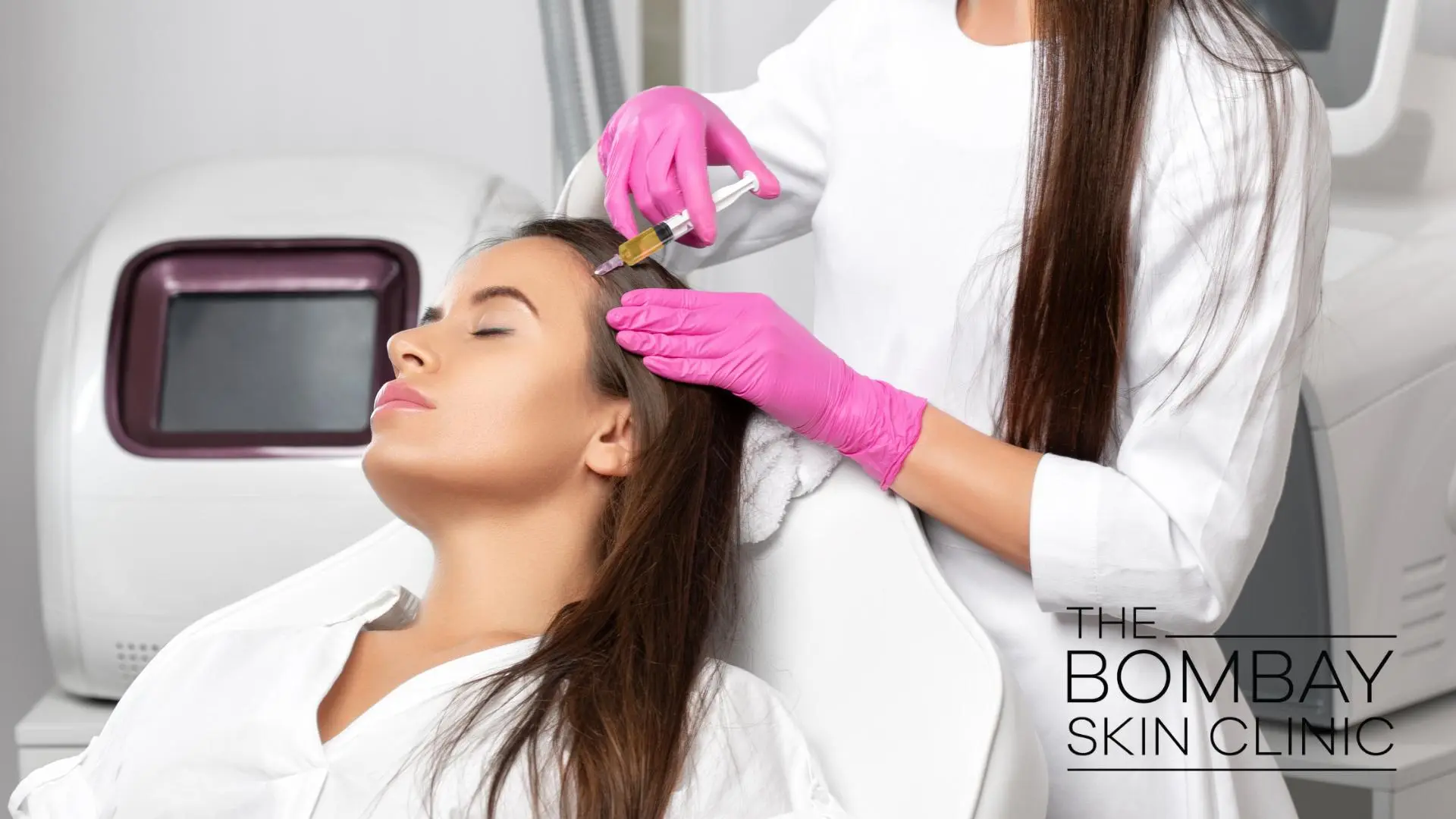
Platelet-Rich Plasma (PRP) is a clinic procedure that uses a small sample of your own blood. We process it to concentrate platelets, which carry growth factors. The prepared PRP is then injected into thinning areas of the scalp under dermatologist oversight.
In hair loss care, PRP is considered a supportive or adjunct option. It can be paired with evidence-based treatments to help improve hair calibre and density in suitable patients. It is not a stand‑alone solution for advanced baldness.
Key Takeaways
- Best for early to moderate pattern hair thinning; outcomes vary. We use it as a supportive therapy alongside medical care [1,2].
- Typical plan: monthly sessions for 3–4 months, then spaced maintenance if helpful; each visit usually takes 45–60 minutes.
- Minimal downtime. Expect temporary scalp tenderness or redness for 24–48 hours.
- Visible changes, if they occur, are gradual: shedding control first (6–8 weeks), texture and density next (3–6 months) [1–3].
- Dermatologist-led, hygienic, and personalised protocols at The Bombay Skin Clinic, South Mumbai.
Advantages of PRP for Hair
- Uses your own blood components; no synthetic fillers are added in our protocol.
- Can support hair follicles in thinning zones and may reduce shedding in suitable cases [1–3].
- Pairs well with standard therapies and low-level light devices when clinically indicated [2,4].
- Clinic-based procedure with minimal downtime and return to routine the same day.
- Structured tracking and trichoscopy allows honest progress checks.
Is PRP Suitable For You?
- Men and women with early-to-moderate androgenetic alopecia (pattern hair loss) after evaluation [1–3].
- Patients noticing increased shedding or reduced hair diameter where medical therapy has begun and needs supportive care.
- Postpartum or stress-related hair fall after medical review to rule out deficiency and thyroid issues.
Who Should Avoid or Delay PRP?
- Active scalp infection, open wounds, or dermatitis at the injection site.
- Uncontrolled chronic illness, bleeding or platelet disorders, or those on certain anticoagulants (requires doctor clearance) [4].
- Pregnancy or breastfeeding; we suggest deferring procedures until after this phase.
- Scarring alopecias or very advanced baldness where transplant or other plans may be more appropriate.
- Unrealistic expectations. We will discuss likely outcomes before starting.
How PRP Works?
Platelets carry signalling proteins known as growth factors. When concentrated and injected into the scalp, these factors can support the hair follicle environment and may improve hair shaft thickness and density in selected patients. Laboratory and clinical studies suggest PRP may extend the hair growth phase and improve blood supply around follicles, but the degree of benefit varies across individuals and studies [1–3].
Current evidence supports PRP as a helpful adjunct in androgenetic alopecia under a trained clinician, with the strongest responses typically in early disease and when combined with standard treatments [1–3].
Your Session Plan & Comfort
Consultation & Trichoscopy
Your first visit includes a medical history, scalp examination, and digital trichoscopy. We review lifestyle, nutrition, and medications; order basic labs if clinically needed; and track changes objectively over time.
Procedure Day
We draw a small sample of blood, process it in a medical-grade centrifuge system, and prepare the PRP under aseptic conditions. The scalp is cleaned, mapped, and numbed. Using fine needles, we place small PRP deposits across the thinning zones. The entire clinical time is typically 45–60 minutes.
Duration & Frequency
A common plan is one session every 4 weeks for 3–4 sessions. If you and your dermatologist observe meaningful progress, maintenance sessions may be spaced every 3–6 months. The number can vary by diagnosis and response [1–3].
Pain & Comfort
With topical anaesthesia and cooling, most people describe the injections as tolerable. You may feel pressure, tingling, or temporary tenderness that settles within 24–48 hours.
Hygiene & Sterility
We follow aseptic protocols: medical-grade devices, single-use consumables, surface disinfection, and biomedical waste norms. Every session is dermatologist-supervised.
Downtime & Daily Routine
- Most patients return to routine work the same day.
- Avoid gym, swimming, steam/sauna, and heavy scalp massage for 24–48 hours.
- Shampoo the next day unless advised otherwise. Use gentle products for a few days.
- Limit alcohol and smoking around the session day; both can affect wound healing.
- Protect the scalp from direct sun for the first 24 hours when outdoors.
Safety, Risks & Side Effects
- Expected temporary effects: redness, swelling, headache, or scalp tenderness for 1–2 days.
- Less common: bruising, itching, or mild flare of dandruff.
- Allergy is unlikely as PRP is autologous. Share any history of reactions to antiseptics or anaesthetics so we can plan accordingly.
- We provide clear aftercare and a contact path if you feel anything unusual.
Realistic Results & Timelines
PRP outcomes are gradual. The first change some patients notice is reduced hair shedding after 6–8 weeks. Next, hair texture and styling ease may improve. Measurable changes in density or hair shaft diameter, where they occur, are typically assessed between 3 and 6 months[1–3].
Response depends on diagnosis, stage of hair loss, associated conditions, and adherence to the combined plan. If we do not see meaningful benefit by review, we will discuss adjusting the plan, adding or switching therapies, or considering surgical options where suitable.
Comparing PRP with Other Options
PRP vs GFC / PRF
GFC (growth factor concentrate) and PRF (platelet-rich fibrin) are related autologous preparations. Techniques and release profiles differ. Some patients prefer PRP because it is well-known and widely studied; others may be candidates for alternative preparations after clinical assessment. Comparative head-to-head data are evolving; we position all of these as supportive options, with choice guided by diagnosis and practicality.
PRP vs Mesotherapy / Microneedling
Mesotherapy and microneedling aim to stimulate the scalp or deliver actives. PRP delivers a concentrated platelet fraction. Evidence for PRP in pattern hair loss is stronger than for many mesotherapy cocktails, while microneedling may be used as a complementary technique in select protocols [2]. Your dermatologist will advise if a combined approach is reasonable.
PRP with Minoxidil/Finasteride/Low-Level Laser
Standard therapies such as minoxidil and finasteride have established roles in androgenetic alopecia. Low-level light devices also have supportive evidence. PRP can be layered with these modalities in appropriate patients to build a comprehensive plan [2,4]. We will sequence treatments safely and set expectations.
PRP vs Hair Transplant
Transplant moves permanent follicles to thinning areas and is considered for advanced pattern hair loss. PRP does not replace transplant in such cases. PRP may be used to support the scalp before or after surgery as advised, or as a non-surgical adjunct in earlier stages.
When PRP May Not Be Enough
In scarring alopecias or advanced thinning where many follicles are miniaturised or lost, PRP is unlikely to create visible density. Sudden, severe hair fall needs medical work-up to rule out triggers such as iron deficiency, thyroid imbalance, medications, or recent illness. In these scenarios, our focus is diagnosis-first and multi-therapy care. We may refer you to a hair transplant surgeon or tailor alternative plans if PRP is not suitable.
Indicative Pricing of PRP Hair Treatment
Pricing varies with the PRP system, single- or double-spin method, consumables, and dermatologist time. At our Mumbai clinic, PRP sessions are priced transparently during consultation. As an indicative guide, pricing starts from Rs.6,000 per session. Packages and maintenance plans are optional and discussed only if you find early sessions helpful.
Why Choose The Bombay Skin Clinic?
- Dermatologist-led care with trichology focus and medical registration details shared at consult.
- Advanced PRP systems with calibrated platelet concentrations as per protocol.
- Personalised plans that integrate medical therapy, devices, and nutrition review.
- Hygiene-first: aseptic technique, single-use kits, biomedical waste compliance, and surface disinfection.
- Structured follow-up and trichoscopy to measure progress honestly.
FAQs
How many PRP sessions do I need, and how often?
Most patients start with one session every 4 weeks for 3–4 sessions. If helpful, maintenance can be spaced every 3–6 months. The plan is personalised after review of your diagnosis and response [1–3].
Is PRP safe for women and after pregnancy?
PRP is autologous and generally well-tolerated. We avoid elective procedures during pregnancy and breastfeeding. For postpartum hair fall, we evaluate nutrition and thyroid first and then consider supportive options as appropriate [4].
Can I combine PRP with minoxidil/finasteride or laser?
Yes, in suitable cases. PRP is often combined with standard therapies and low-level light devices. We will advise the right sequence and timing for safety and comfort [2,4].
What side effects should I watch for at home?
Temporary redness, tenderness, or mild swelling for 1–2 days is expected. Contact us if you notice increasing pain, spreading redness, fever, or any symptom that worries you.
How soon will I see results and how long do they last?
Early signs, if they occur, may appear by 6–8 weeks (reduced shedding). Visible texture or density changes are usually judged between 3 and 6 months. Maintenance is considered if benefits are sustained. Individual response varies [1–3].
PRP vs GFC: which is better for me?
Both are autologous approaches. Choice depends on your diagnosis, expectations, practicality, and clinician recommendation. Comparative evidence is evolving; we consider both as supportive options and will help you decide after examination.
References
- Gentile P, Garcovich S. Systematic review of platelet-rich plasma use in androgenetic alopecia. Int J Mol Sci. https://www.ncbi.nlm.nih.gov/pmc/articles/PMC6200996/
- Alves R, Grimalt R. A review of platelet-rich plasma in androgenetic alopecia. Dermatol Surg. https://pubmed.ncbi.nlm.nih.gov/26990646/
- Gupta AK, Carviel JL. A systematic review of platelet-rich plasma for androgenetic alopecia. J Dermatolog Treat. https://pubmed.ncbi.nlm.nih.gov/27152474/
- American Academy of Dermatology Association. Hair loss: Diagnosis and treatment. https://www.aad.org/public/diseases/hair-loss/treatment/diagnosis-treat
Dr. Batul Patel (Dermatologist)
Medical Director – The Bombay Skin Clinic
Dr. Batul Patel is an award winning certified dermatologist, honoured as the “Dermatologist of the Year 2023” at the national level by The Economic Times. View profile