

Dr. Batul Patel (Dermatologist)
Medical Director – The Bombay Skin Clinic
Dr. Batul Patel is an award winning certified dermatologist, honoured as the “Dermatologist of the Year 2023” at the national level by The Economic Times. View profile
What is Emsella | Treatment Benefits | Good Candidate | How It Works | Expected Results
What is the EMSELLA Chair?
The EMSELLA Chair is a non-surgical pelvic floor treatment that uses high-intensity focused electromagnetic, or HIFEM, technology to stimulate deep pelvic floor muscles. It is commonly discussed for people who have bladder leakage, a weak pelvic floor, or reduced pelvic support.
A proper in-clinic assessment matters because urinary symptoms can have more than one cause, and the right plan depends on your symptoms, medical history, goals, and whether conservative care is appropriate first.[1-4]
What concerns is the EMSELLA Chair usually considered for?
The EMSELLA Chair is usually considered when a person reports symptoms linked to pelvic floor weakness or reduced neuromuscular control. In practice, that often includes:
- Leakage when coughing, sneezing, laughing, lifting, or exercising
- A sense of reduced pelvic support after childbirth or with ageing
- Lower urinary tract symptoms where pelvic floor strengthening may be part of conservative care
- People who struggle to perform pelvic floor exercises correctly or consistently
It is important to remember that not every urinary symptom is caused by pelvic floor weakness. Conditions such as infection, prolapse, prostate-related symptoms, overactive bladder, or other urogynaecology and urology concerns may need a different pathway.[1,2,4]
Why are Mumbai patients asking about the EMSELLA Chair?
Mumbai patients often ask about the EMSELLA Chair because it is fully clothed, non-invasive, and has no routine downtime. For people balancing work, commuting, family life, and social plans, a treatment that fits into a lunch-hour style appointment can feel easier to explore than surgery or a longer rehabilitation pathway.
Another reason is awareness. More patients now understand that leakage after childbirth, during exercise, or later in life is common, but not something they simply have to ignore. That said, common does not mean identical, which is why careful screening remains important before starting any device-based treatment.[1-4]
What are the advantages of EMSELLA Chair treatment?
Why do some patients prefer a fully clothed, non-surgical option?
Some patients prefer the EMSELLA Chair because the session is done while fully clothed and does not involve needles, anaesthesia, or incisions. For the right candidate, that can make the first step feel less intimidating.
Potential advantages include:
- Non-surgical approach
- No routine downtime after a session
- No need to undress during treatment
- Structured, clinic-based support for pelvic floor strengthening
- May help patients who find home exercises difficult to do correctly or regularly
These are practical advantages, not guarantees of outcome. Response varies, and some people still need pelvic floor physiotherapy, bladder training, medicines, or specialist referral depending on the diagnosis.[1-4]
What makes EMSELLA convenient for a busy Mumbai lifestyle?
Convenience is one of the main reasons this treatment gets attention in Mumbai. Sessions are short, there is usually no recovery time, and normal desk work or routine activity can usually continue the same day. That matters for professionals, new mothers, caregivers, and patients who do not want a visible post-procedure recovery period.
Even when a treatment seems convenient, medical judgment still matters. Fast appointments should not mean rushed decisions, especially when symptoms may overlap with gynaecology, urology, postpartum recovery, or age-related pelvic floor changes.
Who may be a good candidate for the EMSELLA Chair?
Who may benefit most from pelvic floor support treatment?
You may be a reasonable candidate for EMSELLA Chair treatment if your symptoms and medical evaluation suggest pelvic floor weakness is a meaningful part of the problem. This may include:
- Women with stress urinary leakage, such as leakage on coughing, sneezing, or exercise
- Postpartum patients with pelvic floor weakness after recovery and medical clearance
- Perimenopausal or older patients with reduced pelvic support and mild to moderate symptoms
- Men or women who need a conservative, non-surgical starting point as part of a broader care plan
Suitability is not based on marketing claims. It is based on symptoms, examination, screening for contraindications, and whether conservative management is appropriate in your case.[1-4]
Who may need a different treatment plan instead?
Some people need a different treatment plan or a specialist work-up first. That may be the case if you have:
- Burning, pain, fever, or symptoms that could suggest infection
- Significant prolapse symptoms, difficulty emptying the bladder, or recurrent urinary tract infections
- Severe urgency, mixed symptoms, or long-standing symptoms that have not been assessed
- Neurological conditions or pelvic symptoms that need multidisciplinary review
- Male urinary symptoms where prostate-related issues may be contributing
In these situations, the safest next step is not to rush into a device session. It is to understand the diagnosis first.[1,2,4]
When is an in-clinic assessment important before starting?
An in-clinic assessment is important before starting in almost every case, because treatment should follow diagnosis, not the other way around. The clinician usually reviews symptom patterns, triggers, timing, medical history, relevant surgeries, childbirth history where relevant, medications, and red flags that may need referral or additional testing.
This also helps set realistic expectations. Some patients improve with pelvic floor support. Others need a combined approach that may include bladder training, lifestyle measures, physiotherapy, medication, or procedural care.[1-4]
How does the EMSELLA Chair work?
What is HIFEM technology and what does it do?
HIFEM stands for high-intensity focused electromagnetic technology. In simple terms, the chair generates electromagnetic energy that stimulates the pelvic floor muscles and triggers strong contractions that are difficult to reproduce voluntarily. The aim is to improve muscle conditioning and neuromuscular control in the pelvic floor region.[3,5]
That mechanism is the reason the treatment is often compared with pelvic floor exercises. It is not exactly the same thing, but the goal overlaps, to improve pelvic floor function in a structured, non-invasive way.
How does pelvic floor muscle stimulation help with bladder control and support?
The pelvic floor supports the bladder, bowel, and, in women, the uterus. When these muscles are weak or poorly coordinated, leakage and reduced support may become more noticeable. By repeatedly stimulating the muscles, the EMSELLA Chair is designed to support strengthening and neuromuscular re-education.[1,3,5]
Even so, bladder control is not only about one muscle group. Fluid habits, urgency patterns, prolapse, menopause, prostate issues, childbirth history, and other factors can all matter. EMSELLA is better understood as one possible supportive option, not a replacement for diagnosis.
What happens during an EMSELLA Chair session?
How long does each session take?
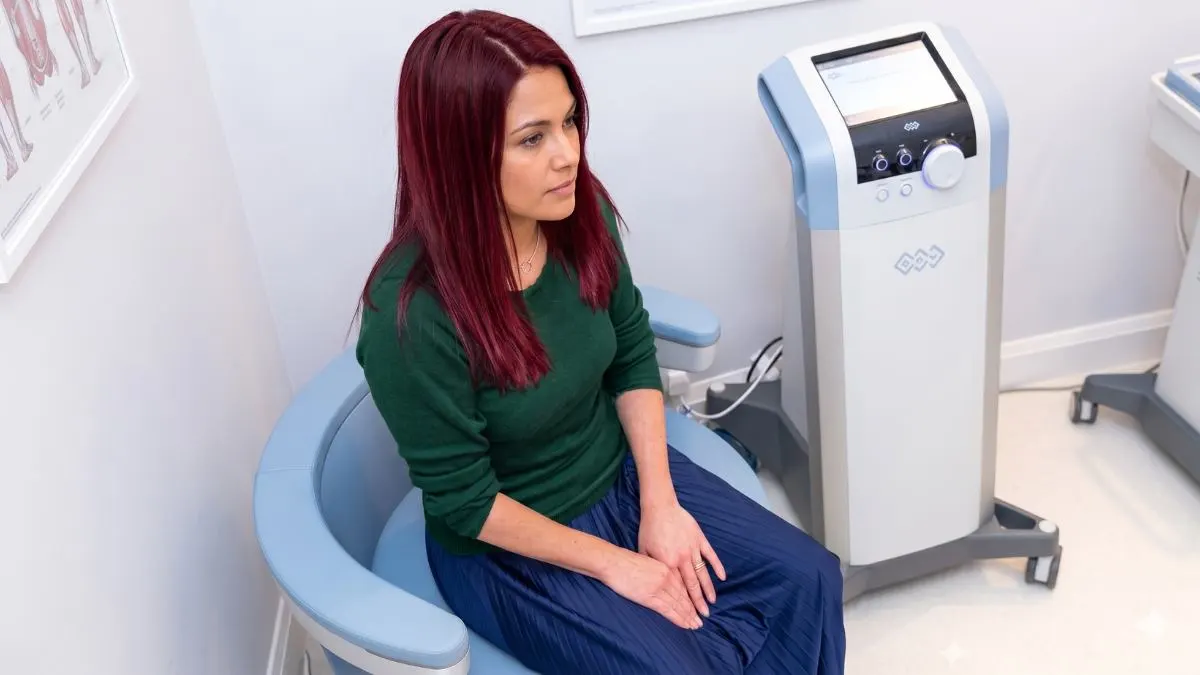
A typical EMSELLA Chair session lasts about 28 to 30 minutes. You remain fully clothed and sit comfortably on the device while the treatment runs. There is no routine need for numbing, sedation, or recovery room time.
How many sessions are usually advised?
A commonly used starter course is six sessions over about three weeks, often at two sessions per week. Some patients may need a different spacing plan or later maintenance based on symptoms, baseline weakness, and response. Maintenance is not automatic for everyone, and it should be individualised after review.
What does the treatment feel like?
Most patients describe the sensation as tingling, tapping, or firm pelvic floor contractions. It can feel unusual at first because the contractions are rhythmic and much stronger than a typical voluntary squeeze. The intensity is usually adjusted gradually for comfort.
It should not feel like a surgical procedure. If someone has pain, significant discomfort, or unusual symptoms, the session should be reassessed rather than pushed through.
Can you return to routine activity the same day?
Yes, routine activity can usually be resumed the same day. Many patients go back to work, errands, or normal movement immediately after the session. Because there is no incision or anaesthesia, routine downtime is not expected.
That said, being able to resume routine activity does not mean the treatment is right for everyone. Safe selection still matters.
What results can you realistically expect, and when?
When do patients usually start noticing improvement?
Some patients notice changes during the treatment course, while others only start noticing improvement after completing the initial sessions. Improvements may include fewer leakage episodes, better control during cough or exercise, or a greater sense of pelvic support. Published studies on HIFEM-based pelvic floor stimulation have shown encouraging short-term improvements in selected groups, especially for stress and mixed urinary incontinence, but study quality and long-term data are still evolving.[3,5]
EMSELLA can be a supportive option for the right person, but it should not be presented as a guaranteed outcome.
How long can results last?
How long results last can vary from person to person. It depends on the baseline issue, age, childbirth history, tissue quality, symptom severity, day-to-day habits, and whether the patient also works on broader pelvic health measures where advised. Some patients maintain benefit for months, while others may notice symptoms gradually returning and ask about maintenance.
Why do some patients need maintenance sessions?
Maintenance sessions may be considered because pelvic floor health is not static. Ageing, childbirth history, menopause, chronic cough, constipation, high-impact exercise, and weight changes can all affect pelvic support over time. If symptoms recur, review comes first. Sometimes maintenance is reasonable. Sometimes another treatment pathway is more appropriate.[1-4]
EMSELLA Chair vs Kegel exercises, physiotherapy and other treatment options
EMSELLA Chair vs pelvic floor exercises at home
Home pelvic floor exercises remain a well-established conservative treatment, especially for stress-predominant symptoms, and are recommended in guidelines when appropriate.[1] The challenge is that many people are unsure whether they are doing the exercises correctly or consistently. EMSELLA may help selected patients who want structured, clinic-based support, but it should not be framed as making exercises irrelevant.
EMSELLA Chair vs pelvic floor physiotherapy
Pelvic floor physiotherapy is often more personalised because it can include assessment, technique correction, breathing work, behavioural strategies, bladder training, and progression over time. EMSELLA is more device-based and less hands-on. In some cases, the best approach is not choosing one over the other, but using them thoughtfully in combination.
EMSELLA Chair vs medicines or procedural options
Medicines and procedures target different problems. Urgency symptoms, overactive bladder, prolapse, prostate-related symptoms, or advanced incontinence may need a different route altogether. Compared with those options, EMSELLA is appealing because it is non-invasive and has no routine downtime, but it is not a substitute for treatments that are needed for a specific diagnosis.[1,2,4]
When is EMSELLA best viewed as an adjunct or supportive option?
EMSELLA is best viewed as an adjunct or supportive option when pelvic floor weakness is part of the problem, but not necessarily the whole story. That is often the most accurate and responsible way to discuss it. In real clinical practice, good outcomes often come from matching the device to the right patient, combining it with conservative care where needed, and avoiding over-promising.[1-5]
Frequently asked questions about EMSELLA Chair treatment
Is EMSELLA painful?
Most patients do not describe it as painful. They usually feel strong pelvic floor contractions, tingling, or a tapping sensation. It can feel unusual at first, but the intensity is typically adjusted gradually for comfort.
Can EMSELLA help after childbirth?
It may be considered as a supportive option for selected postpartum patients after appropriate recovery and medical clearance. Suitability depends on symptoms, healing status, and whether there are other postpartum pelvic concerns that need a different evaluation first.
Is EMSELLA only for women, or can men also consider it?
Men can also be assessed in the right setting, especially when pelvic floor support may be relevant. However, male urinary symptoms can have several causes, including prostate-related issues, so proper evaluation matters before treatment begins.[2,4]
Can EMSELLA replace pelvic floor exercises?
Not always. Pelvic floor exercises remain a well-supported part of conservative care. For some patients, EMSELLA may complement exercise or help when home exercises are difficult to perform correctly, but it should not automatically replace them.[1]
How soon can I resume work, travel or gym?
Routine activity can usually be resumed the same day because there is no routine downtime. If you have unusual symptoms or discomfort, you should check with the clinic rather than assume everything is normal.
How do I know if I am suitable for EMSELLA Chair treatment?
The most reliable way is an in-clinic assessment.That helps clarify the symptom pattern, rule out obvious red flags, review contraindications, and decide whether EMSELLA is appropriate, whether another option is better, or whether a combined plan makes more sense.
Citation Sources
References
- National Institute for Health and Care Excellence. Urinary incontinence and pelvic organ prolapse in women: management (NG123). NICE. https://www.nice.org.uk/guidance/ng123
- National Institute for Health and Care Excellence. Lower urinary tract symptoms in men: management (CG97). NICE. https://www.nice.org.uk/guidance/cg97
- Samuels JB, Pezzella A, Berenholz J, et al. Safety and Efficacy of a Non-Invasive High-Intensity Focused Electromagnetic Field (HIFEM) Device for Treatment of Urinary Incontinence and Enhancement of Quality of Life. Lasers Surg Med. 2019. https://pubmed.ncbi.nlm.nih.gov/31172580/
- Todhunter-Brown A, Hazelton C, Campbell P, et al. Conservative interventions for treating urinary incontinence in women: an overview of Cochrane systematic reviews. Cochrane Database Syst Rev. 2022. https://pmc.ncbi.nlm.nih.gov/articles/PMC9437962/
- Tosun H, et al. Is the High-Intensity Focused Electromagnetic Energy an Effective Treatment for Female Mixed and Stress Urinary Incontinence? Cureus. 2024. https://pubmed.ncbi.nlm.nih.gov/39640007/
Dr. Batul Patel (Dermatologist)
Medical Director – The Bombay Skin Clinic
Dr. Batul Patel is an award winning certified dermatologist, honoured as the “Dermatologist of the Year 2023” at the national level by The Economic Times. View profile