

MEDICALLY REVIEWED BY
Dr. Batul Patel (Dermatologist)
Medical Director – The Bombay Skin Clinic
Dr. Batul Patel is an award-winning celebrity dermatologist with over 20 years of experience. She was honoured as “Dermatologist of the Year 2026” by Financial Express and “Dermatologist of the Year 2023” by The Economic Times. She also served as a jury member at the Vogue Beauty & Wellness Honours 2026. View profile
What Is Volnewmer | How It Works | Side Effects & Safety | Results | Alternatives
Volnewmer is a non-invasive skin tightening platform that uses 6.78 MHz monopolar radiofrequency, or RF, to create controlled heat within the skin while cooling protects the surface. It is mainly considered for mild to moderate skin laxity, early jowling and reduced facial firmness.[1]
The Bombay Skin Clinic does not currently offer Volnewmer. This guide is educational and is designed to help patients in Mumbai understand the technology, realistic outcomes, safety and alternatives before choosing any skin tightening treatment.
What Is Volnewmer Treatment?
Volnewmer treatment uses monopolar RF energy to heat collagen-rich tissue without cutting or puncturing the skin. Electrical resistance converts RF energy into heat, which may support collagen contraction and longer-term remodelling.[1]
Monopolar radiofrequency has a longer evidence base than Volnewmer itself. Reviews suggest that appropriately delivered monopolar RF can improve mild to moderate skin laxity, although results vary by device, settings, treatment area and patient selection.[2]
Is Volnewmer the Same as Radiofrequency Skin Tightening?
Volnewmer is one type of radiofrequency skin tightening. RF is a broad category that includes monopolar, bipolar, multipolar, fractional and microneedling-based systems.
Volnewmer specifically uses monopolar RF. This produces a broader pattern of tissue heating than many lower-powered RF facial devices used mainly for superficial warming.
What Concerns and Areas Can Volnewmer Treat?
Volnewmer is generally considered for early to moderate laxity rather than advanced sagging. Possible treatment areas include the cheeks, lower face, jawline, under-chin region, neck and selected body areas, depending on assessment and tip selection.
- Mild jawline softening and early jowls.
- Reduced cheek or lower-face firmness.
- Mild neck or under-chin skin laxity.
- Fine lines associated with declining skin support.
- Selected areas where gradual firming is the goal.
It does not correct every cause of a poorly defined jawline. Facial fat, volume loss, muscle bulk and bone structure may require different approaches.
What Are the Key Advantages of Volnewmer Monopolar RF?
Volnewmer is designed to provide non-invasive thermal skin tightening while protecting the surface with continuous cooling. Automatic impedance checking and specialised treatment tips are intended to help the operator manage energy delivery and skin contact.[1]
- No needles or surgical incisions.
- Controlled dermal heating to support collagen remodelling.
- Continuous cooling for epidermal protection and comfort.
- Different tips for different treatment areas.
- Usually limited social downtime in suitable patients.
- Gradual change rather than a surgical-looking result.
These features do not make Volnewmer automatically better than other RF systems. Device quality, clinical evidence, operator technique and patient selection remain important.
Who Is a Good Candidate for Volnewmer Treatment?
A typical candidate has mild to moderate skin laxity, realistic expectations and no major contraindication to radiofrequency treatment. It is usually more relevant when reduced skin firmness is the main concern rather than severe tissue descent or major volume loss.
Volnewmer May Be Suitable for You If
- You have early jawline softening or mild jowls.
- Your cheeks or lower face feel less firm.
- You want a non-surgical treatment with little routine disruption.
- You prefer progressive change over weeks to months.
- You understand that RF cannot correct every feature of facial ageing.
Volnewmer May Not Be Suitable for You If
- You are pregnant or breastfeeding and elective treatment is being deferred.
- You have an active infection, open wound or significant inflammation.
- You have a pacemaker or another implanted electronic device that may be incompatible with RF.
- You have relevant metal implants near the treatment area.
- You recently had surgery, threads, filler or another energy-based procedure and need further healing.
When Skin Laxity May Need a Different Treatment Approach
More sagging does not always mean more RF is needed. If the main issue is marked tissue descent, excess skin, facial fat or structural volume loss, another treatment may be more appropriate.
In these cases, monopolar RF may be supportive rather than the main treatment. Focused ultrasound, RF microneedling, volume correction, fat-directed treatment or surgery may be considered after assessment.
How Does Volnewmer Monopolar RF Work?
Volnewmer delivers 6.78 MHz monopolar RF energy into tissue. Electrical resistance converts the current into heat, while surface cooling helps protect the epidermis.[1]
The treatment does not physically pull skin upward. Its effect depends on a thermal biological response, including early collagen contraction and slower collagen remodelling.[3]
How RF Energy Supports Collagen Remodelling and Skin Firmness
Collagen gives the dermis structural support. With ageing and environmental exposure, collagen becomes more fragmented and skin may lose firmness.
Controlled RF heating can alter existing collagen fibres and trigger repair signalling that supports new collagen formation. This is why meaningful improvement usually develops gradually rather than appearing fully on treatment day.[3]
How Volnewmer Controls Energy Delivery, Cooling and Skin Contact
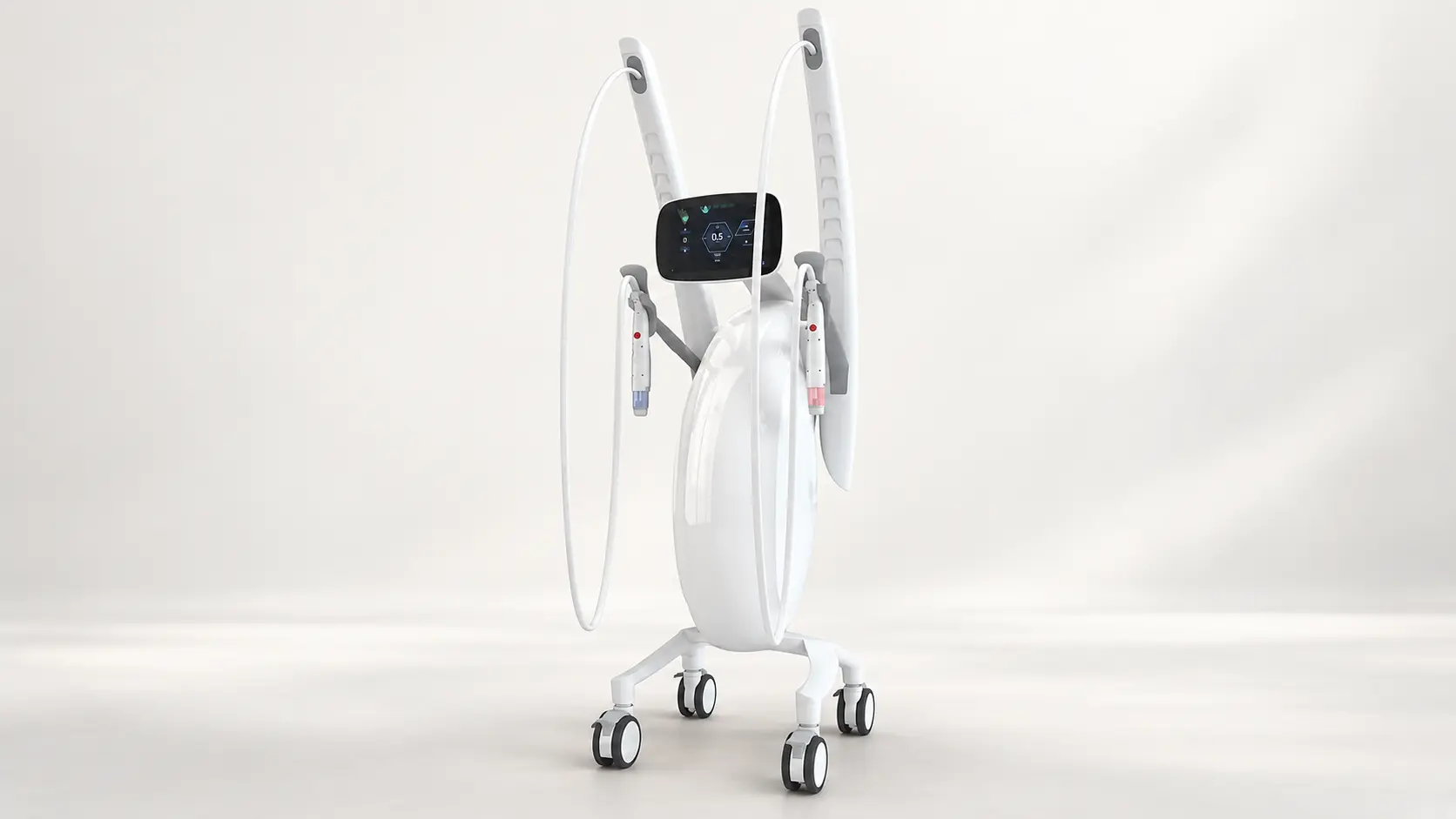
Volnewmer combines a curved treatment tip, automatic impedance checking and continuous water cooling. The system checks tissue resistance, cools the surface and then delivers RF energy while the tip is in contact with the skin.[1]
These features are designed to improve treatment control, but they do not remove risk. Technique, energy selection, skin thickness and patient feedback still matter.
How Volnewmer Differs From a Standard RF Facial Treatment
A standard RF facial may use lower-powered bipolar or multipolar energy mainly for superficial warming. Volnewmer is a medical monopolar RF platform designed for controlled tissue heating at greater depth.
It should therefore be approached as an energy-based medical procedure, with screening and device-specific training, rather than as a simple salon facial.
What Happens During a Volnewmer Treatment Session?
A Volnewmer session should begin with assessment of the patient’s anatomy, medical history and treatment goals. The clinician then maps the treatment area, selects the tip and settings, and delivers RF pulses while monitoring skin contact, heat sensation and response.
Dermatologist Consultation and Treatment Planning
The first question is what is causing the concern. Jawline blurring from loose skin is different from blurring caused by fat, masseter bulk or loss of chin support.
A consultation should also review implants, fillers, threads, recent procedures, sensitivity, pigmentation tendency and expectations before treatment is planned.
How Long Does a Volnewmer Session Take?
Session time varies with the area, tip, number of pulses and treatment protocol. A focused area may be quicker than a full-face or face-and-neck treatment.
Many non-invasive RF tightening sessions fit within roughly 30 to 60 minutes of active treatment, but the full clinic visit can be longer because of consultation, cleansing and mapping.
Is Volnewmer Painful or Uncomfortable?
Volnewmer uses continuous cooling to reduce heat-related discomfort, but it should not be described as painless for everyone. Patients may feel repeated warmth, deep heat or brief stronger pulses, especially in sensitive areas.
Comfort depends on energy level, treatment zone, pain threshold and technique. Excessive heat should be communicated immediately.
How Many Volnewmer Sessions May Be Needed?
There is no universal course. Modern monopolar RF studies include single-session protocols followed for several months, while other RF approaches use repeated sessions.[4]
For Volnewmer, the session count should be explained by the treating clinic and linked to laxity, area and response, rather than prescribed as the same package for everyone.
What Is the Downtime After Volnewmer?
Volnewmer is generally positioned as a low-downtime procedure. Many patients can return to routine activity soon after treatment.
Temporary redness, warmth, tenderness or mild swelling can occur. Low visible downtime does not mean zero biological effect or zero risk.
Is Volnewmer Safe? Side Effects, Precautions and Contraindications
Monopolar RF has an established clinical history, and published reviews generally describe an acceptable safety profile when treatment is performed with suitable patient selection and technique.[2] Volnewmer is still an energy-based medical procedure, so safety depends on both the device and the operator.
Common Temporary Effects After Treatment
Systematic reviews of RF rejuvenation report mostly temporary effects such as discomfort, redness and swelling. Less common complications can include burns, prolonged irritation, pigment change or contour irregularity, depending on the device and protocol.[5]
- Redness or warmth.
- Mild swelling.
- Temporary tenderness or tightness.
- Brief sensitivity.
Persistent pain, blistering, marked swelling or a new contour depression should be reviewed promptly by the treating medical team.
When Volnewmer Should Be Avoided or Delayed
Treatment may need to be avoided, postponed or medically cleared when there is pregnancy, active infection, open skin, significant inflammation, an implanted electronic device, relevant metal implants, altered sensation or a recent procedure in the treatment area.
The exact contraindications should come from the device instructions for use and an individual medical assessment.
Volnewmer and Indian Skin Tones
RF does not depend on melanin absorption in the same way as many light-based treatments, so it can be considered across a wide range of skin tones. A prospective study in Asian patients with Fitzpatrick Skin Types III to V reported improvement in mild to moderate lower facial laxity without serious adverse events in that study.[4]
Indian patients with melasma, reactive skin, dermatitis or a history of post-inflammatory pigmentation still need personalised assessment.
Why Dermatologist Oversight Matters With Monopolar RF
Safe treatment is not only about selecting an energy number. It involves deciding where to treat, where to reduce or avoid energy, and whether RF matches the patient’s anatomy at all.
Dermatologist oversight is especially useful when there are fillers, threads, pigmentation concerns, thin tissue, facial asymmetry or recent procedures.
What Results Can You Expect From Volnewmer and When?
Volnewmer should be expected to produce gradual, natural-looking improvement rather than a surgical lift. The degree of change varies with age, skin quality, laxity, treatment area, energy delivery and individual collagen response.
Immediate Changes Versus Gradual Collagen Remodelling
An early feeling of firmness may occur after monopolar RF because of collagen contraction and temporary tissue response. This is not the final result.
More meaningful change depends on collagen remodelling, which can continue over the following months.[3]
When Do Volnewmer Results Usually Become Noticeable?
Some people may notice subtle early tightening, but results are usually assessed over several weeks to a few months. In an Asian monopolar RF study, improvement continued through 1, 3 and 6 months after a single treatment.[4]
Volnewmer-specific timelines can vary, so it is better to discuss a range than promise a fixed week.
How Long May Volnewmer Results Last?
There is no single duration for every patient. Results may persist for months, but ageing continues and visible longevity is influenced by age, sun exposure, smoking, weight change, hormones and the starting degree of laxity.
Repeat treatment should be based on reassessment rather than a fixed maintenance calendar alone.
What Volnewmer Can and Cannot Realistically Achieve
Volnewmer may support firmer-looking skin, a slightly more defined lower face and improvement in mild laxity. It cannot reproduce a facelift, restore major volume loss, remove large fat deposits or correct severe tissue descent.
The realistic goal is improvement, not transformation.
Volnewmer vs Other Skin Tightening Treatments
There is no single skin tightening device that is best for everyone. Volnewmer, Thermage, HIFU, Ultraformer MPT, XERF, Density RF and MNRF use different energy patterns and may suit different tissue concerns.
Volnewmer vs Thermage
Both Volnewmer and Thermage are monopolar RF technologies using 6.78 MHz radiofrequency. They differ in tip engineering, cooling, feedback systems and treatment workflow.
Thermage has a longer clinical and commercial history, while Volnewmer is newer. The choice should consider evidence, device authenticity, operator experience and patient anatomy, not only the brand name.
Volnewmer vs HIFU
Volnewmer uses radiofrequency for broad thermal heating, while HIFU uses focused ultrasound to create concentrated thermal points at selected depths.
A small randomized split-face trial found improvement with both monopolar RF and microfocused ultrasound, with no statistically significant difference in investigator-rated face and neck laxity.[6] This supports choosing by anatomy and goals rather than assuming one energy source is universally superior.
Volnewmer vs Ultraformer MPT
Ultraformer MPT is a focused ultrasound platform. Ultrasound can target defined focal depths, while monopolar RF creates broader heating through electrical resistance.
Focused ultrasound may be considered when deeper structural tightening is a priority. Monopolar RF may be considered when broad dermal heating and firmness are central goals.
Volnewmer vs XERF and Density RF
Volnewmer uses single-frequency 6.78 MHz monopolar RF. XERF uses multi-frequency monopolar RF, while Density RF can combine monopolar and bipolar RF within its platform.
These engineering differences affect heat distribution, but they do not prove that one device will be better for every patient. Clinical evidence, technique and patient selection remain central.
Volnewmer vs RF Microneedling or MNRF
Volnewmer is non-invasive and does not use needles. RF microneedling, or MNRF, inserts fine needles and delivers RF energy at controlled depths.
MNRF is often considered when acne scars, pores and texture are important concerns along with mild laxity. Volnewmer is more directly positioned for non-invasive tightening where needle-based resurfacing is not the main goal.
When a Combination Skin Tightening Plan May Be Considered
A combination may be useful when ageing affects more than one layer, such as laxity plus volume loss, pigmentation, scarring or submental fullness.
The aim should not be to stack devices. Each treatment should have a clear role, and enough time should be allowed to judge response before adding another procedure.
Volnewmer Treatment Cost in Mumbai
Public Indian market listings suggest that Volnewmer may start from around ₹1,00,000 per session and can cost more depending on the area, pulse count and protocol. This is only indicative market information and should be verified directly with the treating clinic.
What Determines the Cost of Volnewmer Treatment?
- Treatment area and size.
- Number of pulses or shots.
- Tip type and consumables.
- Provider experience and medical supervision.
- Whether treatment is standalone or part of a staged plan.
- Follow-up arrangements.
Patients should also ask about device authenticity, who performs the procedure and what medical support is available if a reaction occurs.
Frequently Asked Questions About Volnewmer Treatment
Is Volnewmer painful?
Volnewmer uses continuous cooling to reduce heat-related discomfort, but individual sensation varies. Patients may feel repeated warmth or deep heat. Excessive heat or sharp pain should be communicated immediately during treatment.
How many Volnewmer sessions do I need?
There is no universal number. Some modern monopolar RF protocols use one session followed by review over several months, while other treatment plans use repeat sessions. The schedule should depend on laxity, area, response and the provider’s protocol.
How soon will I see results after Volnewmer?
Some early firmness may be noticeable soon after treatment, but collagen-related improvement usually develops over several weeks to a few months. The first-day appearance should not be treated as the final result.
Is Volnewmer better than Thermage or HIFU?
No single technology is better for every patient. Volnewmer and Thermage are monopolar RF systems, while HIFU uses focused ultrasound. The appropriate option depends on tissue depth, laxity pattern, comfort preference and expected level of change.
Is Volnewmer suitable for all Indian skin tones?
Monopolar RF can be considered across a broad range of skin tones because melanin is not its main energy target. However, melasma, sensitivity, dermatitis and previous procedures still influence treatment planning.[4]
Can Volnewmer be used for the jawline, neck and early jowls?
These are common areas considered for monopolar RF when mild to moderate skin laxity is the main problem. If the concern is driven mainly by fat, volume loss or advanced tissue descent, another treatment or combination may be more appropriate.
References and Medical Sources
- CLASSYS. VOLNEWMER. CLASSYS. https://classys.com/product/volnewmer/
- Rohrich RJ, Schultz KP, Chamata ES, Bellamy JL, Alleyne B. Minimally Invasive Approach to Skin Tightening of the Face and Body: Systematic Review of Monopolar and Bipolar Radiofrequency Devices. Plast Reconstr Surg. 2022;150(4):771-780. https://pubmed.ncbi.nlm.nih.gov/35877937/
- Kilmer SL, et al. Monopolar Radiofrequency for Dermal Prejuvenation: Scientific Rationale and Mechanisms of Action. Lasers Surg Med. 2026;58(2):63-69. https://pubmed.ncbi.nlm.nih.gov/41456098/
- Wanitphakdeedecha R, Yogya Y, Yan C, et al. Efficacy and Safety of Monopolar Radiofrequency for Treatment of Lower Facial Laxity in Asians. Dermatol Ther (Heidelb). 2022;12(11):2563-2573. https://pubmed.ncbi.nlm.nih.gov/36166188/
- Vassão PG, Balão AB, Credidio BM, et al. Radiofrequency and skin rejuvenation: a systematic review. J Cosmet Laser Ther. 2022;24(1-5):9-21. https://pubmed.ncbi.nlm.nih.gov/35856592/
- Alhaddad M, Wu DC, Bolton J, et al. A Randomized, Split-Face, Evaluator-Blind Clinical Trial Comparing Monopolar Radiofrequency Versus Microfocused Ultrasound With Visualization for Lifting and Tightening of the Face and Upper Neck. Dermatol Surg. 2019;45(1):131-139. https://pubmed.ncbi.nlm.nih.gov/30531187/
MEDICALLY REVIEWED BY
Dr. Batul Patel (Dermatologist)
Medical Director – The Bombay Skin Clinic
Dr. Batul Patel is an award-winning celebrity dermatologist with over 20 years of experience. She was honoured as “Dermatologist of the Year 2026” by Financial Express and “Dermatologist of the Year 2023” by The Economic Times. She also served as a jury member at the Vogue Beauty & Wellness Honours 2026. View profile