

MEDICALLY REVIEWED BY
Dr. Batul Patel (Dermatologist)
Medical Director – The Bombay Skin Clinic
Dr. Batul Patel is an award-winning celebrity dermatologist with over 20 years of experience. She was honoured as “Dermatologist of the Year 2026” by Financial Express and “Dermatologist of the Year 2023” by The Economic Times. She also served as a jury member at the Vogue Beauty & Wellness Honours 2026. View profile
What Is NEW DOUBLO 2.0™ | How It Works | Results | Side Effects & Safety | Alternatives
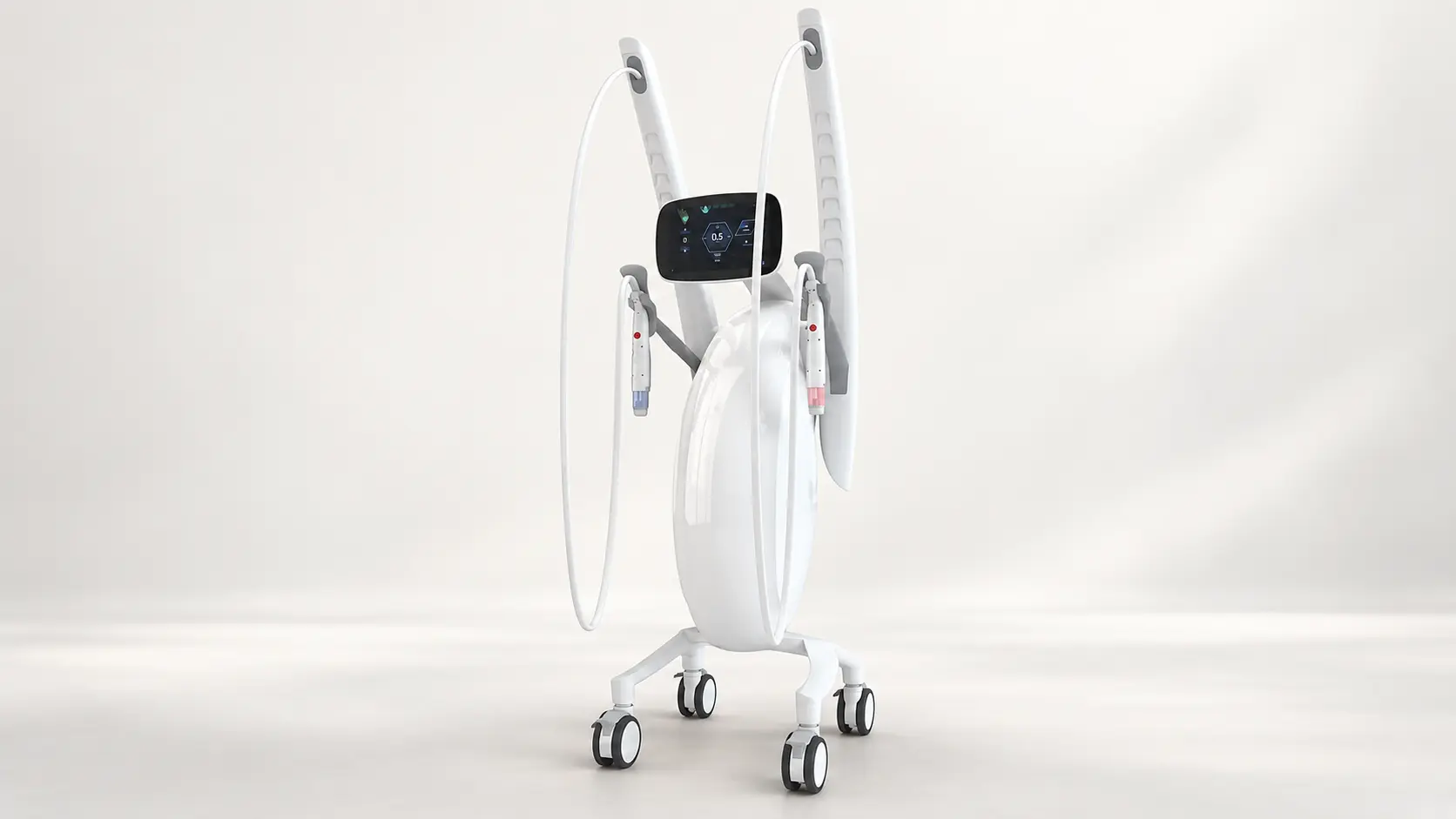
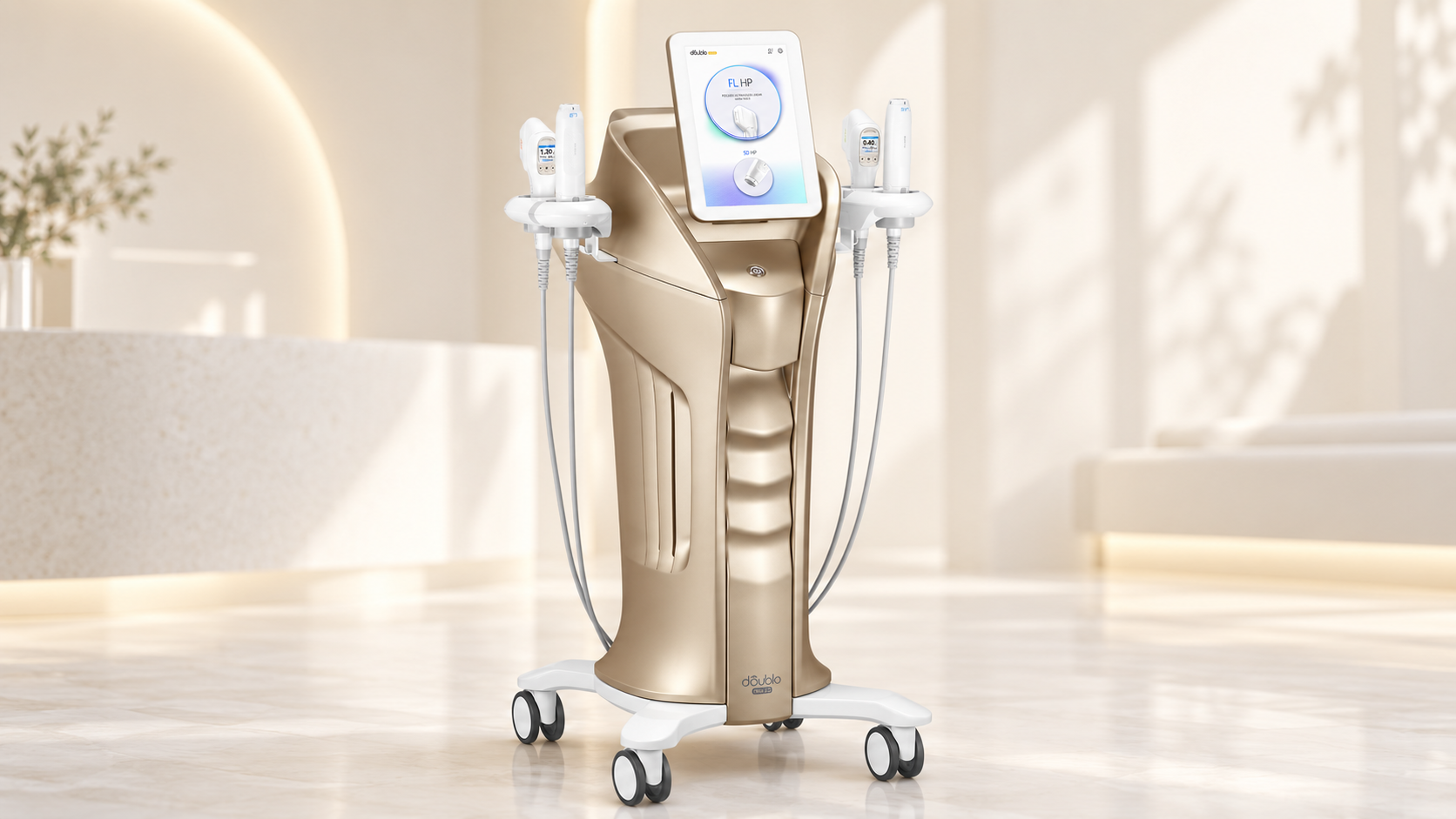
NEW DOUBLO 2.0™ is a non-surgical skin tightening platform that combines microfocused ultrasound, or MFU, with radiofrequency, or RF. It is designed for gradual improvement in mild to moderate laxity, firmness and facial contour rather than surgical-level lifting.
The Bombay Skin Clinic does not currently offer NEW DOUBLO 2.0™. This guide is intended to explain the technology from a dermatologist-led perspective, including how it works, where the evidence stands, who may be considered for treatment and how it compares with other skin-tightening options.
What Is NEW DOUBLO 2.0™?
NEW DOUBLO 2.0™ is an aesthetic platform developed by HIRONIC. It combines focused ultrasound with RF-based heating, allowing treatment at different tissue levels while leaving the skin surface largely intact.[1]
It supports non-surgical tightening and collagen remodelling, but does not reproduce a surgical facelift.
What Does MFU + RF Mean in NEW DOUBLO 2.0™?
MFU uses focused acoustic energy to create small thermal zones at selected depths below the skin, which can stimulate collagen remodelling.[3] RF uses electrical energy to generate controlled heat within collagen-rich tissue and is also used for non-ablative skin tightening.[4]
In NEW DOUBLO 2.0™, these two energy types can be used within the same treatment plan.
What Is Synergy Dotting Technology?
Synergy Dotting is the device-specific mode that combines RF and focused ultrasound. The manufacturer describes RF heating being delivered first, followed by focused ultrasound at a selected depth.[1]
A 2023 split-face study using the V-RO, NEW DOUBLO platform found that combined ultrasound plus bipolar RF improved selected measures more than ultrasound alone in 22 adults.[2] The study is encouraging, but too small to prove superiority for every patient.
How Does NEW DOUBLO 2.0™ Work?
NEW DOUBLO 2.0™ creates controlled thermal stimulation at different tissue levels. MFU produces focal heating at planned depths, while RF can create broader heating closer to the skin surface.[1][2]
The aim is to trigger collagen contraction and remodelling. Improvement therefore develops gradually rather than appearing as an instant surgical lift.
How Microfocused Ultrasound, MFU, Targets Deeper Tissue
Microfocused ultrasound concentrates energy at defined focal depths instead of heating all tissue evenly. Different cartridges allow the clinician to select treatment depth according to the area and anatomy.
Systematic reviews show MFU can improve mild to moderate facial laxity, with outcomes often assessed around 90 and 180 days.[3]
What Does Radiofrequency, RF, Add to the Treatment?
RF produces controlled heating through a broader tissue volume. Reviews of non-ablative RF support its use for improving skin laxity, elasticity and other signs of facial ageing, although devices and protocols vary.[4]
In an MFU RF treatment, RF may complement the more focal action of ultrasound by addressing more superficial tissue layers.
Why Combine MFU and RF in the Same Treatment Protocol?
MFU and RF have different energy profiles. Combining them may allow a dermatologist to address deeper laxity and more superficial firmness within the same plan.
Device-specific evidence suggests a possible additive effect for selected skin parameters.[2] We consider the combination an option for suitable patients, not an automatic upgrade.
How Is NEW DOUBLO 2.0™ Different From Conventional HIFU?
Conventional HIFU or MFU skin tightening relies mainly on focused ultrasound. NEW DOUBLO 2.0™ adds RF capability, including Synergy Dotting, so the treatment can include both focal ultrasound and broader RF heating.[1]
This gives the platform more flexibility, but suitability still depends on the patient’s anatomy and concern.
HIFU Alone vs MFU + RF: What Changes?
With HIFU or MFU alone, planning centres on ultrasound depth, energy and coverage. With MFU plus RF, the clinician also considers how RF heating may support the response in more superficial layers.
One small study reported additional improvement in selected measures with the combination.[2] Larger independent studies are still needed.
Does Combining Two Energy Technologies Make NEW DOUBLO 2.0™ Suitable for Everyone?
No. More technology does not automatically produce a better result. Significant loose skin, marked volume loss, heavy jowls or concerns driven mainly by fat or bone structure may respond poorly to skin tightening alone.
Treatment should follow diagnosis. Sometimes another device or staged combination is more appropriate.
What Skin Concerns Can NEW DOUBLO 2.0™ Address?
NEW DOUBLO 2.0™ is mainly considered for mild to moderate laxity and reduced firmness. It may support contour definition when the main problem is skin and soft-tissue laxity rather than major structural change.
- Early facial laxity
- Reduced jawline definition
- Mild jowling
- Loose-looking neck skin
- Reduced firmness and elasticity
NEW DOUBLO 2.0™ for Facial Skin Laxity and Firmness
For facial laxity, treatment may be mapped across the cheeks and lower face according to tissue thickness, with gradual improvement in firmness as the goal.
Patients seeking a dramatic facelift-type change should understand that a non-invasive device has different limits.
NEW DOUBLO 2.0™ for the Jawline, Jowls and Lower Face
Early laxity can soften the jawline and create mild jowling. MFU can target selected deeper levels while RF may support more superficial firmness.
Jawline shape also depends on chin structure, facial fat and volume loss, so tightening is not always the whole answer.
NEW DOUBLO 2.0™ for the Neck and Under-Chin Area
Selected patients with mild under-chin or upper-neck laxity may be considered. Careful mapping matters because the neck contains important nerves, glands and vessels.
If under-chin fullness is mainly fat, a different or staged treatment may be more appropriate.
Who Is a Good Candidate for NEW DOUBLO 2.0™?
A suitable candidate is usually an adult with mild to moderate skin laxity who wants gradual, non-surgical improvement and accepts that results vary. Skin thickness, facial volume, previous procedures and general health all affect suitability.
NEW DOUBLO 2.0™ May Be Considered For
- Early loss of facial firmness
- Mild to moderate lower-face or neck laxity
- Softening of jawline definition
- People seeking non-surgical skin tightening in Mumbai
- Patients who prefer limited recovery time
- Concerns involving both deeper laxity and superficial firmness
Who May Not Be an Ideal Candidate?
- People with advanced skin laxity where surgery may create a more meaningful change
- Anyone with active infection, open wounds or significant inflammation in the treatment area
- Pregnant patients, because elective energy-based aesthetic procedures are usually deferred
- People with certain implanted electrical or metallic devices, depending on location and device instructions
- Patients with impaired healing or uncontrolled medical conditions
- Anyone expecting an immediate or surgical-level lift
Previous fillers, threads, surgery and other energy procedures should be disclosed because they can affect timing and treatment mapping.
What Happens During a NEW DOUBLO 2.0™ Treatment Session?
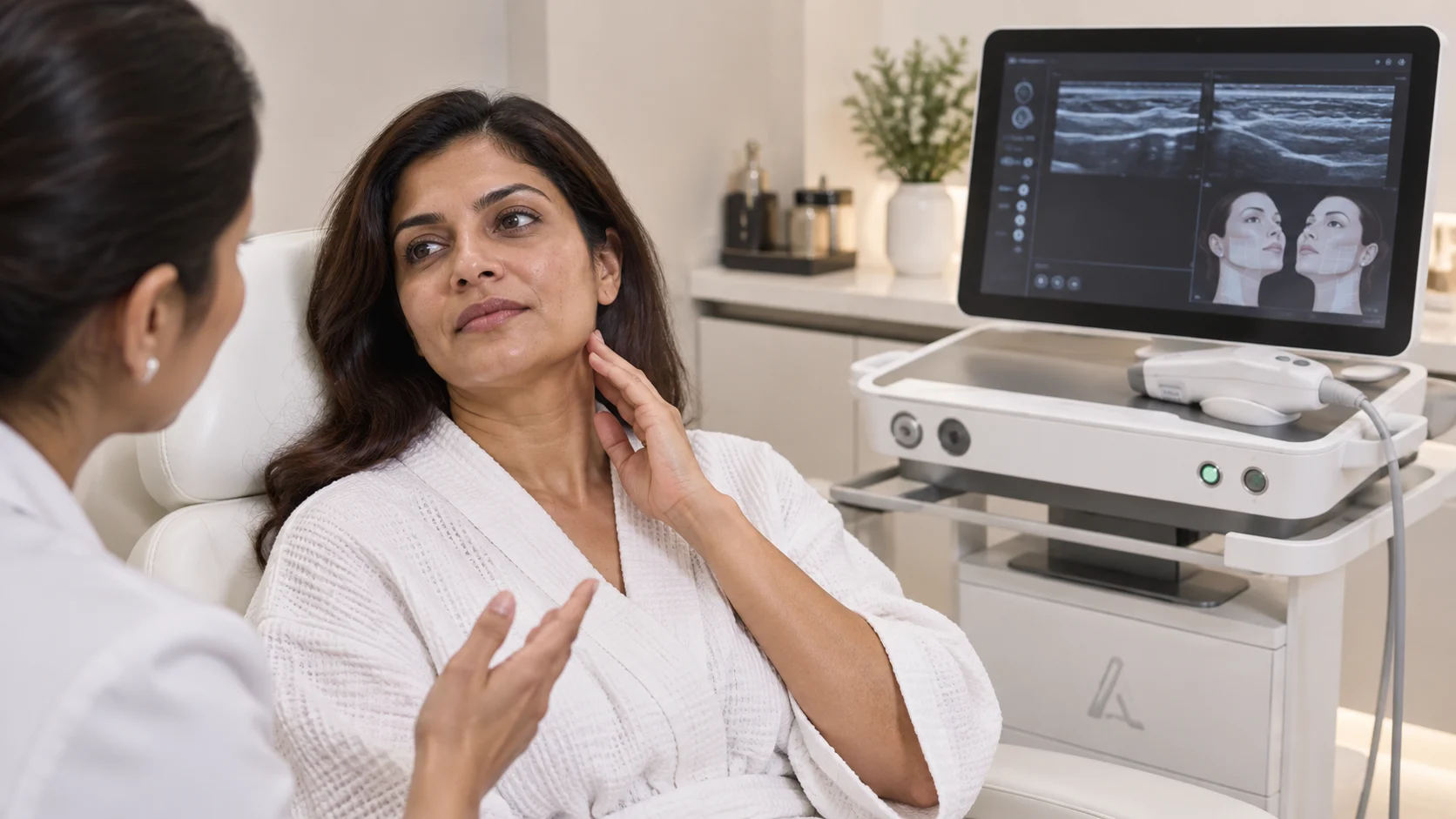
A session begins with assessment, cleansing and mapping. The dermatologist selects areas, depths and handpieces according to laxity and facial anatomy.
A coupling medium may be used where required, then energy is delivered systematically across the planned zones.
Dermatologist Assessment, Facial Mapping and Treatment Planning
Facial mapping matters because tissue depth changes from the cheek to the jawline and neck. A safe protocol should not copy identical settings across every area.
In our clinical approach at The Bombay Skin Clinic, we first determine whether the concern is mainly laxity, fat, volume loss, texture or a combination. Because we do not currently offer NEW DOUBLO 2.0™, this assessment is used to discuss suitable skin-tightening options that are available at our clinic rather than to plan a NEW DOUBLO 2.0™ treatment.
How Long Does a NEW DOUBLO 2.0™ Session Take?
A focused facial appointment may take around 30 to 60 minutes, depending on the areas, passes, handpieces and comfort measures. Larger or combination protocols can take longer.
The device is designed for rapid energy delivery, but treatment speed should not replace careful mapping and coverage.[1]
Is NEW DOUBLO 2.0™ Painful or Uncomfortable?
Patients may feel heat, tingling, pressure or brief prickling sensations. Bony areas and the jawline can feel more sensitive.
MFU studies show variable discomfort levels, so comfort cannot be predicted exactly.[3] Treatment should be adjusted for safety and tolerability rather than pushing energy unnecessarily.
How Many NEW DOUBLO 2.0™ Sessions Are Usually Needed?
Many ultrasound-based tightening plans begin with one session followed by reassessment. Some patients may later benefit from another session or staged plan.
There is no universal course because laxity, age, tissue thickness and treatment coverage vary.
What Results Can You Expect From NEW DOUBLO 2.0™?
Results are usually gradual. Early firmness may be noticed, but the main objective is progressive collagen remodelling over the following weeks.
For MFU generally, systematic reviews report improvement around 90 days, with changes sometimes persisting at 180 days and beyond.[3] Evidence specific to NEW DOUBLO 2.0™ remains smaller.
When Do NEW DOUBLO 2.0™ Results Start to Show?
Some people notice early tightening within days or weeks, but this is not the final result. A more useful review point is often around 8 to 12 weeks, when collagen remodelling is further established.
Improvement may continue after that depending on the protocol and individual response.
How Does Collagen Remodelling Develop Over Time?
Controlled heat can cause some existing collagen fibres to contract and can start a natural repair response. Fibroblasts, the skin cells that produce collagen, then become more active. Over the following weeks and months, new collagen is formed and existing collagen fibres are reorganised, which can gradually improve firmness and support.
This is why NEW DOUBLO 2.0™ does not behave like a filler or surgery. Its effects depend on the patient’s own gradual collagen-remodelling response.
How Long May NEW DOUBLO 2.0™ Results Last?
There is no fixed duration for everyone. Results may remain visible for many months while natural ageing continues.
Age, laxity, sun exposure, smoking, weight change and treatment intensity can influence longevity.
What NEW DOUBLO 2.0™ Cannot Achieve
NEW DOUBLO 2.0™ cannot reproduce surgical tissue repositioning, replace lost facial volume or change bone structure. It also should not be expected to remove a significant fat deposit simply by tightening the skin.
Where these factors dominate, the treatment may be supportive rather than the main solution.
What Is the Downtime After NEW DOUBLO 2.0™?
Downtime is usually limited because MFU and non-ablative RF do not intentionally remove the outer skin surface. Many patients can return to routine activities soon after treatment.
Temporary warmth, redness, swelling, tenderness or sensitivity can occur.
What Can You Expect Immediately After Treatment?
The skin may look mildly flushed or feel warm, tender or slightly swollen. These effects are generally short-lived in MFU and RF literature.[3][4]
Persistent pain, blistering, marked swelling, weakness, prolonged numbness or another unexpected symptom should be assessed by the treating doctor.
When Can You Return to Work, Exercise and Normal Activities?
Many patients can return to desk work and social activity the same day. Exercise, saunas or heavy heat exposure may need brief modification if the skin remains warm or sensitive.
If another procedure has been combined, recovery advice may differ.
Is NEW DOUBLO 2.0™ Safe? Side Effects and Contraindications
MFU and non-ablative RF have established safety literature, but neither is risk-free.[3][4] Safety depends on patient selection, anatomy, contact, treatment depth and appropriate energy.
NEW DOUBLO 2.0™ should follow device guidance and clinician training, not copied online settings.
Common Temporary Effects After Treatment
- Redness or warmth
- Mild swelling
- Tenderness or tingling
- Temporary sensitivity or numbness
- Brief discomfort during energy delivery
Less common focused-ultrasound complications reported in the literature include burns, bruising and altered sensation.[3]
When Should NEW DOUBLO 2.0™ Be Avoided or Postponed?
Treatment may be avoided, postponed or modified with active infection, open wounds, significant inflammation, pregnancy, certain implanted electronic devices, relevant metal in the treatment field, impaired healing or uncontrolled medical illness.
Recent fillers, threads, surgery and other energy treatments require individual review because contraindications and timing differ by handpiece and area.
Why Treatment Depth, Energy Selection and Facial Anatomy Matter
Energy-based procedures depend on where and how energy is delivered. Inappropriate depth, excessive energy or treating the wrong anatomical zone can increase risk, while inadequate coverage may provide little benefit.
The objective is therefore the appropriate setting for the tissue, not the highest setting a patient can tolerate.
NEW DOUBLO 2.0™ vs Other Skin Tightening Technologies
There is no single best skin tightening treatment for every face. The useful comparison is which energy profile matches the patient’s main concern, anatomy and expected downtime.
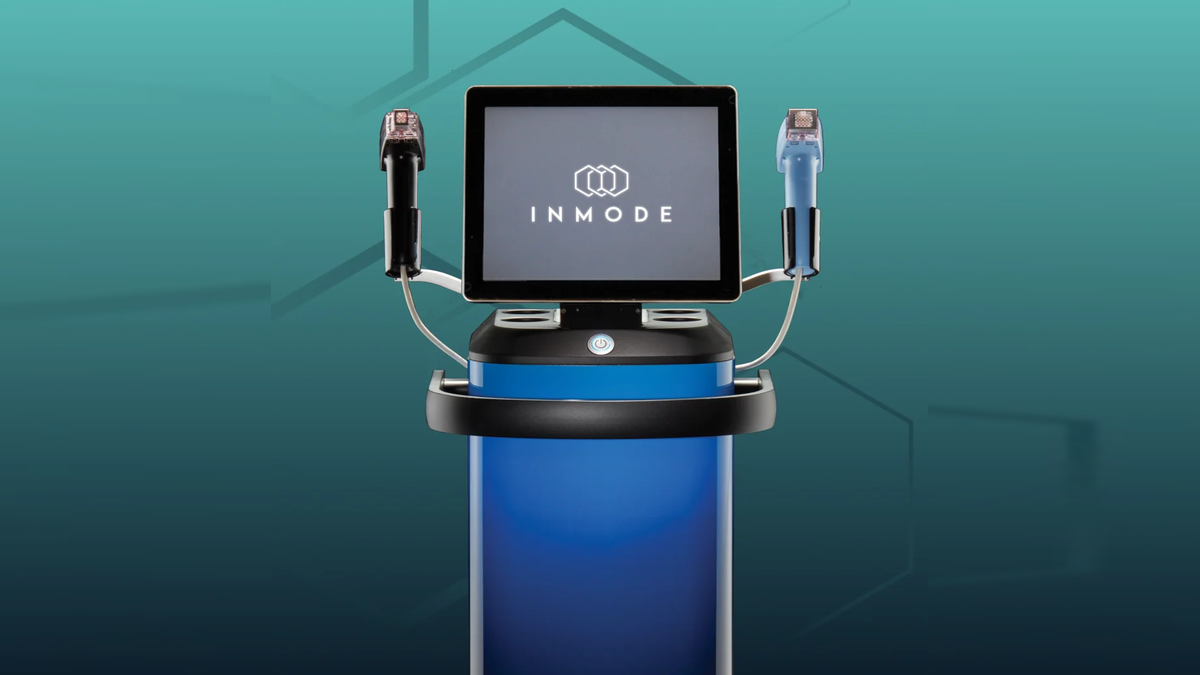
NEW DOUBLO 2.0™ vs Ultraformer MPT
Ultraformer MPT is primarily a micro and macro focused ultrasound platform. NEW DOUBLO 2.0™ adds RF capability, so its treatment architecture can include focal ultrasound and broader RF heating.
Ultraformer MPT may suit an ultrasound-led plan, while NEW DOUBLO 2.0™ may be considered when combined MFU and RF is clinically relevant. Neither is automatically better.
NEW DOUBLO 2.0™ vs Standalone HIFU
Standalone HIFU relies on focused ultrasound. NEW DOUBLO 2.0™ can combine focused ultrasound with RF through Synergy Dotting.[1]
A small device-specific study found additional improvement in selected measures with combined ultrasound and bipolar RF, but the evidence is not strong enough to promise superior results for everyone.[2]
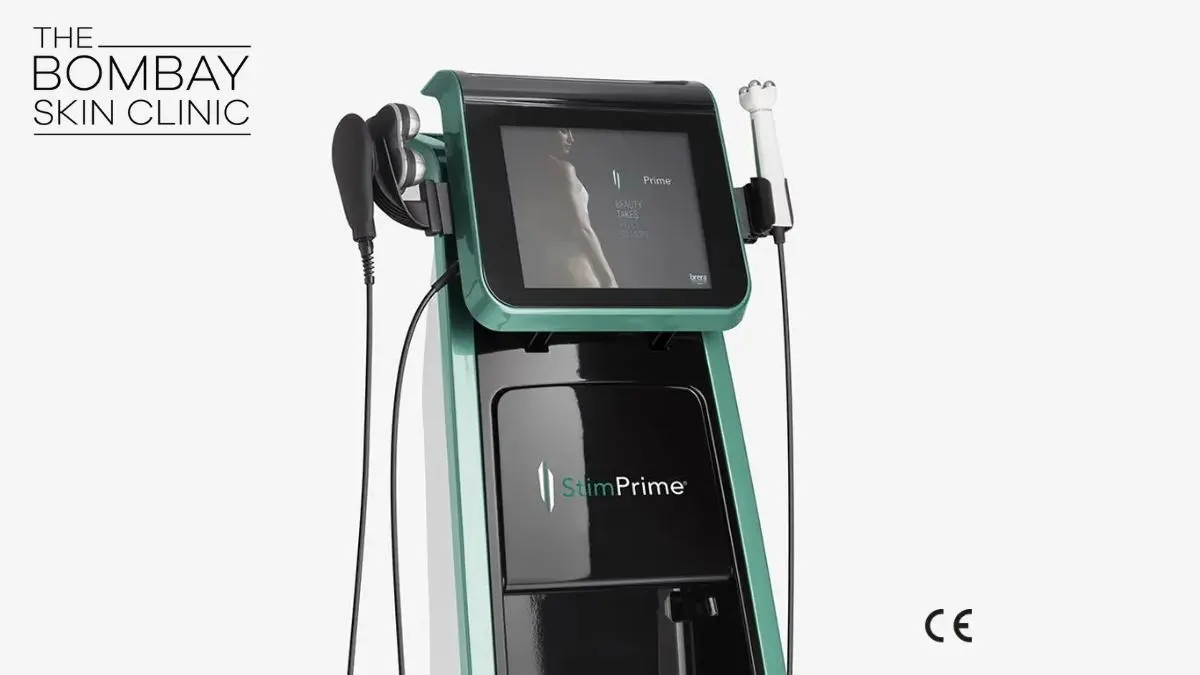
NEW DOUBLO 2.0™ vs Radiofrequency Skin Tightening and Density RF
Standalone RF treatments focus on radiofrequency heating. DENSITY RF, for example, is an RF platform using monopolar and bipolar RF rather than focused ultrasound.
NEW DOUBLO 2.0™ differs because it can combine RF with MFU. A dermal-firmness concern may suit an RF-led plan, while deeper laxity may lead to ultrasound or a combined approach.
NEW DOUBLO 2.0™ vs RF Microneedling
RF microneedling uses needles to deliver RF at controlled depths and is often considered when texture, pores or acne scarring are major goals. Non-invasive MFU plus RF Synergy Dotting works differently and does not create needle channels.
If laxity and contour are the priority, a non-invasive tightening plan may be more relevant.
How Does a Dermatologist Choose Between These Technologies?
At The Bombay Skin Clinic, we assess skin laxity, facial fat, volume loss, bone support, skin thickness, texture, previous treatments, downtime preference and the degree of change expected.
We then choose among the treatments and technologies available at our clinic. NEW DOUBLO 2.0™ is discussed in this article as a comparative technology and is not currently offered by The Bombay Skin Clinic.
How Much Does NEW DOUBLO 2.0™ Cost in Mumbai?
NEW DOUBLO 2.0™ cost in Mumbai depends on the area, number of zones, handpieces, treatment depth and coverage. A small focused area cannot be directly compared with a full-face or face-and-neck protocol.
Pricing should therefore be interpreted together with the treatment map, not just the device name.
Indicative NEW DOUBLO 2.0™ Treatment Cost in Mumbai
At clinics that do offer the device, pricing can vary according to the treatment area, coverage, number of passes, handpieces and whether MFU and RF are used together. Patients comparing prices should ask exactly what the quoted protocol includes.
What Factors Affect NEW DOUBLO 2.0™ Pricing?
- Size and number of areas
- Face alone versus face and neck
- Number and depth of passes
- Whether the planned protocol uses MFU alone or MFU plus RF
- Cartridges or handpieces required
- Staged or combination treatment
When comparing quotes, ask what area and coverage are included rather than comparing only the headline price.
Frequently Asked Questions About NEW DOUBLO 2.0™
Is NEW DOUBLO 2.0™ the Same as HIFU?
No. NEW DOUBLO 2.0™ includes focused ultrasound, but it also has RF capability. Its Synergy Dotting mode combines RF heating with focused ultrasound delivery, which differs from a conventional ultrasound-only HIFU protocol.[1]
Is NEW DOUBLO 2.0™ Better Than Regular HIFU?
Not necessarily. A small split-face study found that combined ultrasound and bipolar RF improved some measures more than ultrasound alone, but the evidence remains limited.[2] The more appropriate option depends on the concern, anatomy and desired depth of treatment.
Is NEW DOUBLO 2.0™ Painful?
Patients may feel heat, tingling, pressure or brief prickling sensations. Discomfort varies by area, energy, depth and individual sensitivity, so it should not be described as completely painless.[3]
How Many NEW DOUBLO 2.0™ Sessions Do I Need?
Many patients begin with one treatment and are reviewed after several weeks. Further treatment or maintenance may be considered according to response, laxity and goals rather than using the same fixed course for everyone.
Is NEW DOUBLO 2.0™ Suitable for Indian Skin Tones?
MFU and non-ablative RF do not primarily target melanin, so these technologies can be considered across a wide range of skin tones when appropriately selected. An Indian study of microfocused ultrasound reported improvement with acceptable safety, although it evaluated MFU rather than NEW DOUBLO 2.0™ specifically.[5]
Skin sensitivity, recent tanning, active inflammation and any combination procedure should still be assessed individually.
References
- HIRONIC Co., Ltd. NEW DOUBLO 2.0: MFU & RF Synergy Technology for Skin Rejuvenation. HIRONIC. https://www.newdoublotwo.com/
- Byun JW, Kang YR, Park S, Hong W. Efficacy of radiofrequency combined with single-dot ultrasound efficacy for skin rejuvenation: A non-randomized split-face trial with blinded response evaluation. Skin Research and Technology. 2023;29:e13452. https://pubmed.ncbi.nlm.nih.gov/37753689/
- Ling J, Zhao H. A Systematic Review and Meta-Analysis of the Clinical Efficacy and Patients’ Satisfaction of Micro-focused Ultrasound Treatment for Facial Rejuvenation and Tightening. Aesthetic Plastic Surgery. 2023;47(5):1806-1823. https://pubmed.ncbi.nlm.nih.gov/37198297/
- Austin GK, Struble SL, Quatela VC. Evaluating the effectiveness and safety of radiofrequency for face and neck rejuvenation: A systematic review. Lasers in Surgery and Medicine. 2022;54(1):27-45. https://pubmed.ncbi.nlm.nih.gov/34923652/
- Shome D, Vadera S, Ram MS, Khare S, Kapoor R. Use of Micro-focused Ultrasound for Skin Tightening of Mid and Lower Face. Plastic and Reconstructive Surgery Global Open. 2019;7(12):e2498. https://pubmed.ncbi.nlm.nih.gov/32537285/
MEDICALLY REVIEWED BY
Dr. Batul Patel (Dermatologist)
Medical Director – The Bombay Skin Clinic
Dr. Batul Patel is an award-winning celebrity dermatologist with over 20 years of experience. She was honoured as “Dermatologist of the Year 2026” by Financial Express and “Dermatologist of the Year 2023” by The Economic Times. She also served as a jury member at the Vogue Beauty & Wellness Honours 2026. View profile