

MEDICALLY REVIEWED BY
Dr. Batul Patel (Dermatologist)
Medical Director – The Bombay Skin Clinic
Dr. Batul Patel is an award-winning celebrity dermatologist with over 20 years of experience. She was honoured as “Dermatologist of the Year 2026” by Financial Express and “Dermatologist of the Year 2023” by The Economic Times. She also served as a jury member at the Vogue Beauty & Wellness Honours 2026. View profile
Non-Surgical Options | Who Is Eligible | How It Works | Safety & Risks | Treatment Cost
Sagging skin along the jawline, a softened jaw contour, or early jowling are among the most common concerns we hear at our clinic. Many patients want visible firming without the downtime, scars, or recovery time of a surgical facelift. The good news is that dermatology now offers several non-surgical facelift options that work by stimulating your skin’s own collagen and elastin, gradually lifting and tightening from within.
This guide compares the four most requested non-surgical facelift options – High-Intensity Focused Ultrasound (HIFU), monopolar radiofrequency (the technology behind Thermage), microfocused ultrasound devices such as Ultraformer, and polydioxanone (PDO) thread lifts – so you can understand how each works before your consultation.
In a city like Mumbai, where humidity, sun exposure, and long working hours can add to visible skin fatigue, many patients ask us for an option that fits around a busy schedule with little to no time away from work. Non-surgical facelift options were developed for exactly this reason: they use focused energy or fine sutures rather than a scalpel, so most patients can walk in during a lunch break and return to their routine the same day.
What Is a Non-Surgical Facelift?
A non-surgical facelift is an umbrella term for energy-based or mechanical treatments that lift and firm the skin without incisions or general anaesthesia. Instead of removing excess skin the way a surgical facelift does, these treatments trigger the skin’s natural wound-healing response, encouraging new collagen and elastin to form over the following weeks and months [1].
HIFU and microfocused ultrasound devices (including Ultraformer) use focused sound energy to heat precise points deep in the skin and the SMAS layer, the same connective tissue plane a surgeon would tighten in an operating theatre. Radiofrequency devices like Thermage heat the deeper dermis more broadly using electrical current, while PDO thread lifts use dissolvable sutures with tiny barbs or cones to mechanically reposition tissue while stimulating collagen as they dissolve [2][3].
Although these four options are often grouped together as “non-surgical facelifts,” they are not interchangeable. Each reaches a different depth of tissue, produces a different type of lift, and suits a different stage of skin laxity. Understanding these differences before your consultation can help you ask more informed questions and set realistic expectations for what any single session, or a combination, can achieve.
Key Advantages of Non-Surgical Facelift Options
Patients who are not yet ready for surgery, or who simply prefer a more gradual approach to ageing skin, often find these treatments a helpful supportive step. Some of the most commonly cited advantages include the following.
- No incisions or general anaesthesia – treatments are performed with topical numbing cream in an outpatient setting.
- Minimal downtime – most patients return to work and daily activities within a day or two.
- Gradual, natural-looking improvement – collagen remodelling unfolds over weeks, so change is progressive rather than sudden.
- Can be personalised – your dermatologist may combine modalities, for example ultrasound for deep lifting with threads for targeted contouring, based on your concern.
- Lower risk profile than surgery, though it is not risk-free and results are more modest than a surgical lift.
- Repeatable – most of these treatments can be safely repeated at appropriate intervals as part of an ongoing skin maintenance plan.
Who Is It For? Eligibility at a Glance
You May Be a Good Candidate If
- You have mild to moderate skin laxity of the lower face, jawline, or neck rather than significant excess skin.
- You are generally in good health with realistic expectations of gradual, supportive improvement.
- You are looking to delay, rather than replace, a future surgical facelift.
- You want a treatment that fits around work commitments with little disruption to your routine.
It May Not Be Right for You If
- You have significant skin or soft-tissue excess, where a surgical facelift is likely to give a more proportionate result.
- You are pregnant or breastfeeding.
- You have active skin infections, unhealed wounds, or certain implanted devices in the treatment area.
- You have a history of keloid scarring or a bleeding disorder that has not been assessed by a doctor.
- You expect results identical to surgery within days of a single session.
Your dermatologist at our clinic will examine your skin laxity, bone structure, and medical history in person before recommending a specific option or combination. This assessment also considers your skin’s thickness and elasticity, since these factors influence how well tissue responds to ultrasound or radiofrequency energy.
How Non-Surgical Facelift Treatments Work
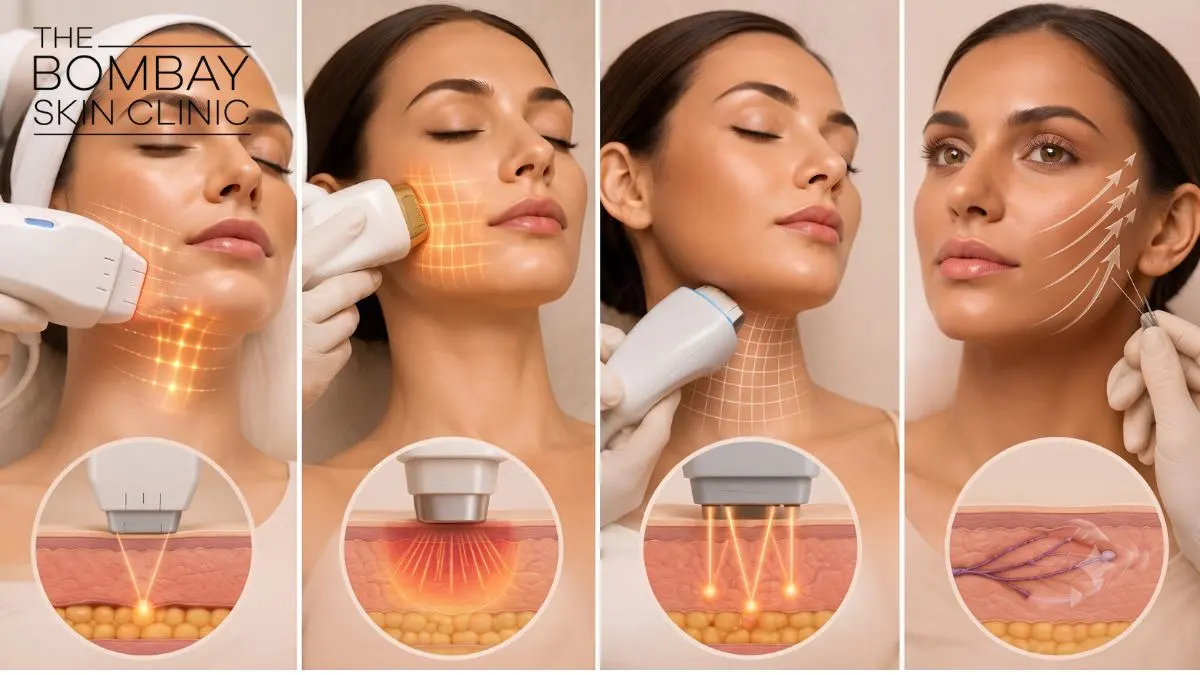
HIFU (High-Intensity Focused Ultrasound): HIFU delivers focused ultrasound energy to precise depths under the skin, including the SMAS layer, without damaging the surface. A handheld transducer allows the treating dermatologist to target this energy at specific millimetre depths in a grid-like pattern, creating controlled thermal injury points that trigger new collagen formation over the following two to three months. Systematic reviews and meta-analyses report measurable improvements in skin laxity and patient satisfaction, particularly for the lower face and neck [4].
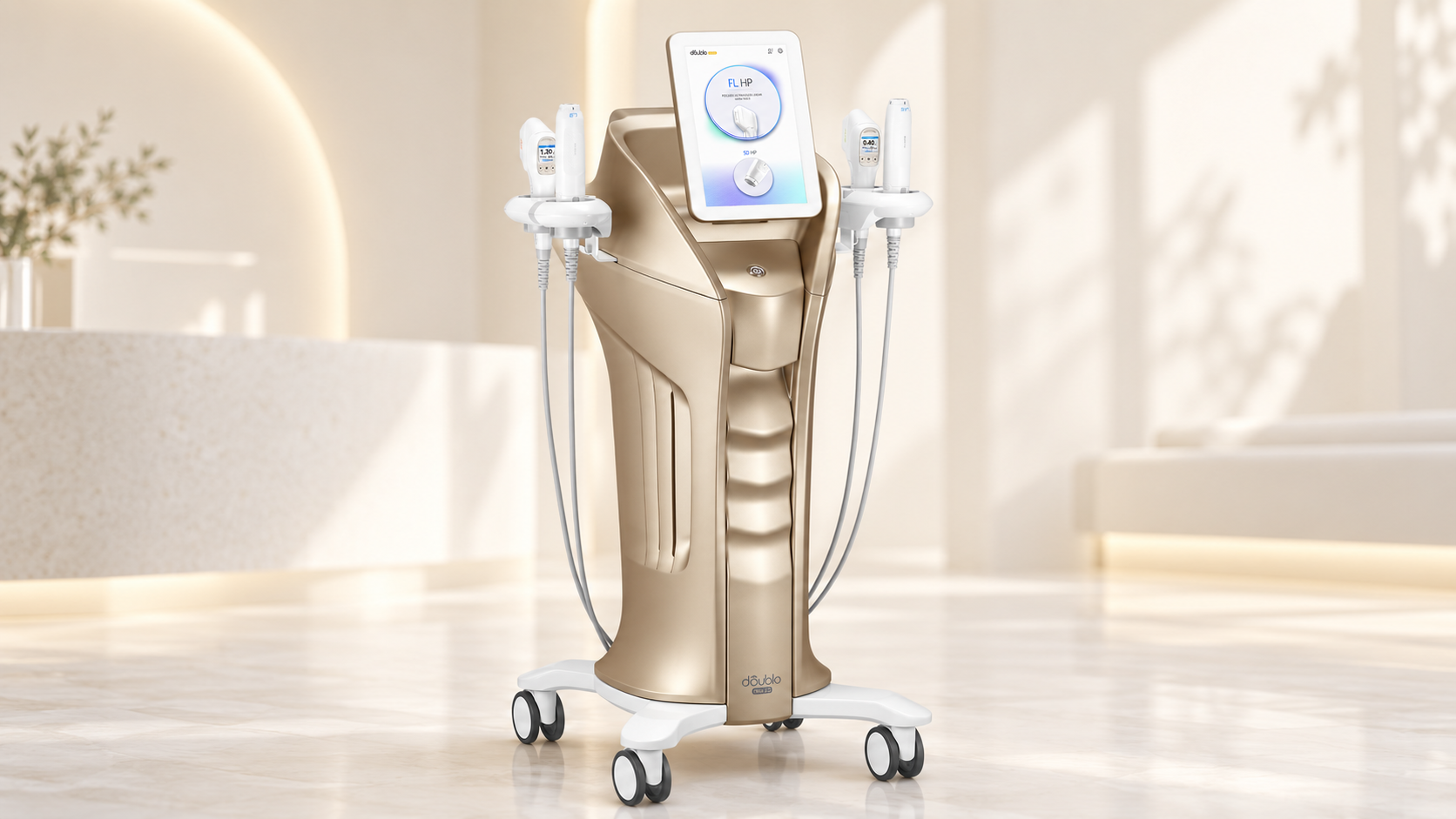
Thermage (Monopolar Radiofrequency): Thermage uses monopolar radiofrequency current to heat the reticular dermis in a broad, controlled pattern while a cooling tip protects the skin’s surface. The heat denatures existing collagen fibres and stimulates fresh collagen and elastin production over subsequent months. Because the energy is delivered across a wider treatment tip rather than a narrow focal point, Thermage tends to treat larger surface areas more evenly in a single pass. Monopolar RF was among the first technologies to receive regulatory approval for periocular and facial skin tightening and remains a well-studied option in the dermatology literature [5].
Ultraformer and Similar Microfocused Ultrasound Devices: Ultraformer is a microfocused ultrasound platform that works on a similar principle to HIFU, delivering ultrasound energy at multiple depths in a single session. Some devices allow adjustable depth and energy settings, which can make treatment more customisable for different facial zones, for example using a shallower setting near delicate areas and a deeper setting over the jawline. Evidence for microfocused ultrasound shows collagen-stimulating effects broadly comparable to HIFU, with outcomes depending heavily on device settings and operator experience [1].
PDO Thread Lifts: Thread lifts use fine, dissolvable polydioxanone sutures inserted under the skin through a needle or blunt cannula. Barbed or cogged threads mechanically grip tissue to create an immediate, subtle lift, while the thread itself dissolves over four to six months, leaving behind a scaffold of new collagen. Because the lifting effect is partly mechanical, threads can produce a more immediately visible change in tissue position compared with the purely energy-based options, though this effect is more localised. Thread lifts are often chosen for more targeted contouring of the jawline, cheeks, or brow rather than broad skin tightening [3].
Many patients ask whether these energy-based options can be paired with injectables. Your dermatologist may suggest reviewing our dermal filler options separately, since volume loss and skin laxity often need to be addressed together for a balanced result.
Your Session Plan and Comfort
How Long Each Session Takes
A full-face HIFU or Ultraformer session typically takes 45 to 90 minutes, depending on the areas covered. Thermage sessions for the face and neck usually run 60 to 90 minutes because the device passes over the skin in a grid pattern, with each pulse carefully mapped to avoid overlapping or missed areas. Thread lift sessions are generally shorter, often 30 to 60 minutes, since they are localised to specific zones such as the jawline, cheeks, or brow. Topical numbing cream is applied 30 to 45 minutes before most sessions for comfort, and most patients describe sensations ranging from warmth to brief moments of heat or pressure during energy delivery, or a mild pulling sensation as threads are placed.
How Many Sessions You May Need
HIFU and Ultraformer are usually performed as a single session, with some patients opting for a repeat session after 9 to 12 months to maintain results. Thermage is also typically a single annual session per treatment cycle, since its collagen-remodelling effect builds gradually and additional passes too soon may not add meaningful benefit. Thread lifts are usually a single procedure, with threads dissolving fully within about six months; a repeat lift may be considered after 12 to 18 months if desired. Some patients choose to combine two modalities, such as ultrasound for overall tightening with threads for targeted jawline definition, though this is decided case by case. Your dermatologist will confirm a plan suited to your skin and goals only after an in-person assessment.
Safety and Contraindications
While these treatments are generally well tolerated, they are medical procedures and carry some risk. A thorough consultation helps identify who should avoid or defer treatment.
- All four treatments should be avoided during pregnancy and breastfeeding.
- Active acne, cold sores, or skin infections in the treatment area should be treated and resolved first.
- Patients with pacemakers or certain implanted electronic devices should discuss radiofrequency treatments with their physician beforehand.
- Thread lifts carry specific risks including thread migration, dimpling, infection, and, rarely, injury to nearby nerves or the parotid gland; these are more likely when thread placement is not individualised to facial anatomy [3].
- Temporary redness, swelling, tenderness, or numbness can occur with any of these treatments and usually settles within days.
- Rare but reported effects of ultrasound and radiofrequency devices include temporary nerve weakness, small areas of fat loss, or uneven results if energy settings are not matched to skin thickness.
- A qualified dermatologist should always assess your skin, medical history, and any medications before treatment to confirm suitability.
Results and Realistic Timelines
None of these treatments produce an immediate, dramatic lift the way surgery can. Collagen remodelling is a biological process, so most patients begin noticing gradual firming from around six to eight weeks after HIFU, Ultraformer, or Thermage, with continued improvement over three to six months as new collagen matures [4][6]. Thread lifts can offer a more immediate, subtle repositioning effect from the mechanical lift, in addition to the slower collagen-building benefit as the thread dissolves.
Results vary from person to person depending on baseline skin laxity, age, skin quality, and lifestyle factors such as sun exposure and smoking. Patients with thicker, more elastic skin often see a more visible response than those with very thin or significantly sun-damaged skin. These treatments are supportive options that soften visible signs of laxity; they do not replace the more substantial, longer-lasting change a surgical facelift can achieve for significant skin excess. Maintenance sessions, typically annual, are usually needed to sustain results as natural ageing continues, and your dermatologist will advise on realistic timelines specific to your skin at your consultation.
How It Compares to Related Treatments
Compared with a surgical facelift, all four non-surgical options involve no incisions, no general anaesthesia, and far less downtime, but they also produce a more modest, gradual improvement rather than removing excess skin. Compared with dermal fillers, which primarily restore lost volume, these treatments focus on tightening existing skin and are often used alongside fillers rather than instead of them. Compared with each other, HIFU and Ultraformer reach deeper tissue planes for more structural lifting, Thermage covers a broader area with a smoother, blanket-style heating pattern, and thread lifts offer the most immediate, localised repositioning with the shortest procedure time.
Choosing between them often comes down to the area of concern and how much time you can allow for gradual improvement. A patient with generalised jawline softening across a wide area may respond well to Thermage or HIFU, while someone concerned mainly with a specific pocket of laxity near the jaw corner may be a better fit for a targeted thread lift. Patients often ask about combining a HIFU skin tightening session with other skin tightening treatments for a layered approach. Our dermatologists can also walk you through our specific Thermage FLX comparison and Ultraformer MPT protocols to see which technology suits your skin and budget.
Why Choose The Bombay Skin Clinic
At The Bombay Skin Clinic, every non-surgical facelift plan begins with an assessment by our dermatologist-led team, not a generic package. We invest in advanced, well-maintained technology and follow strict hygiene and sterilisation protocols for every energy-based and thread-based procedure. Our experienced, qualified medical team is trained to match device settings, thread type, and technique to your individual skin type and concern, rather than applying a single protocol to every patient.
Because Mumbai’s heat, humidity, and pollution can affect how skin responds to any energy-based treatment, our dermatologists factor local climate and your lifestyle into your personalised treatment protocol, so your plan is built around your skin, not a one-size-fits-all approach. We also provide clear aftercare guidance and follow-up so you know what to expect at each stage of your collagen-remodelling timeline.
Indicative Pricing
Treatment costs for non-surgical facelift options depend on the areas treated, the technology chosen, the number of passes or threads required, and the complexity of your individual concern. Because of this, we do not publish fixed prices for HIFU, Thermage, Ultraformer, or thread lift procedures online. Your dermatologist will provide a personalised cost estimate only after an in-person consultation and clinical assessment of your skin.
Frequently Asked Questions
Which non-surgical facelift option suits me?
There is no single option that suits every patient. Your dermatologist will recommend HIFU, Thermage, Ultraformer, threads, or a combination based on your skin laxity, facial anatomy, and goals after an in-person examination.
Does a non-surgical facelift hurt?
Most patients feel warmth, brief heat, or pressure rather than significant pain, especially with topical numbing cream applied beforehand. Thread lifts may cause mild pulling sensations during insertion, and any discomfort typically eases quickly once the session ends.
How long do results from HIFU, Thermage, or Ultraformer last?
Many patients notice supportive firming for around 9 to 12 months, though this varies with age, skin quality, and lifestyle. Periodic maintenance sessions are typically recommended to sustain results as the skin continues to age naturally.
Is there any downtime after these treatments?
Most patients resume normal activities within a day or two. Mild redness, swelling, or tenderness can occur and usually settles quickly. Thread lifts may involve slightly more visible swelling or bruising initially, which typically improves within a week.
Can these treatments be combined with dermal fillers or Botox?
Yes, many patients combine skin-tightening treatments with fillers or neuromodulators for a more complete result. Your dermatologist will sequence treatments appropriately during your consultation to avoid interference between procedures.
At what age should I consider a non-surgical facelift?
These treatments are typically considered by patients in their thirties to sixties who have mild to moderate laxity. Your dermatologist will advise whether a non-surgical option or a referral for surgical consultation better suits your degree of skin excess.
References
- A Systematic Review of the Efficacy of Microfocused Ultrasound for Facial Skin Tightening. National Center for Biotechnology Information. https://www.ncbi.nlm.nih.gov/pmc/articles/PMC9861614/
- Fabi SG, Goldman MP. Radiofrequency in cosmetic dermatology: a review of clinical evidence. J Cosmet Dermatol. https://pubmed.ncbi.nlm.nih.gov/31691477/
- Facial Thread Lifting Complications. J Cosmet Dermatol. National Center for Biotechnology Information. https://www.ncbi.nlm.nih.gov/pmc/articles/PMC11702150/
- Systematic review and meta-analysis of safety and efficacy of high-intensity focused ultrasound (HIFU) for face and neck rejuvenation. National Center for Biotechnology Information. https://pubmed.ncbi.nlm.nih.gov/32026164/
- Clinical application of radiofrequency technology in the treatment of facial skin wrinkles and laxity. National Center for Biotechnology Information. https://pmc.ncbi.nlm.nih.gov/articles/PMC12243918/
- Long-Term Efficacy and Safety of a Novel Monopolar Radiofrequency Device for Skin Tightening: A Prospective Randomized Controlled Study. National Center for Biotechnology Information. https://pubmed.ncbi.nlm.nih.gov/39957006/
MEDICALLY REVIEWED BY
Dr. Batul Patel (Dermatologist)
Medical Director – The Bombay Skin Clinic
Dr. Batul Patel is an award-winning celebrity dermatologist with over 20 years of experience. She was honoured as “Dermatologist of the Year 2026” by Financial Express and “Dermatologist of the Year 2023” by The Economic Times. She also served as a jury member at the Vogue Beauty & Wellness Honours 2026. View profile